A person collapses at home, in a break room, on a youth sports sideline, or in a patient care area. In those first moments, most people do not need more information. They need someone nearby who knows what to do. That is why CPR training is important - it turns hesitation into action when oxygen is not reaching the brain and every minute changes the outcome.
CPR is not just a certification line or a box to check for a job. It is a practical response skill for one of the most time-sensitive emergencies a person can face. Whether you are a parent, teacher, office manager, coach, nurse, medical assistant, or caregiver, training gives you a clear role in a crisis before EMS arrives.
Why CPR training is important in the first few minutes
Cardiac arrest is different from a heart attack, and that distinction matters. In cardiac arrest, the heart stops pumping blood effectively. Without circulation, the brain and other organs begin to suffer damage quickly. A delayed response can mean the difference between recovery, permanent injury, and death.
CPR helps maintain blood flow to vital organs until more advanced care is available. It is not a cure by itself, and trained responders should never think of it that way. But it buys time, and in emergency care, time is often the most valuable thing available.
This is where training matters more than good intentions. People who have never practiced CPR often freeze, panic, or second-guess themselves. They may worry about pressing too hard, doing the steps out of order, or making the situation worse. Structured instruction reduces that uncertainty. It gives people a sequence to follow under pressure and a physical skill they have actually rehearsed.
CPR training builds confidence, not just knowledge
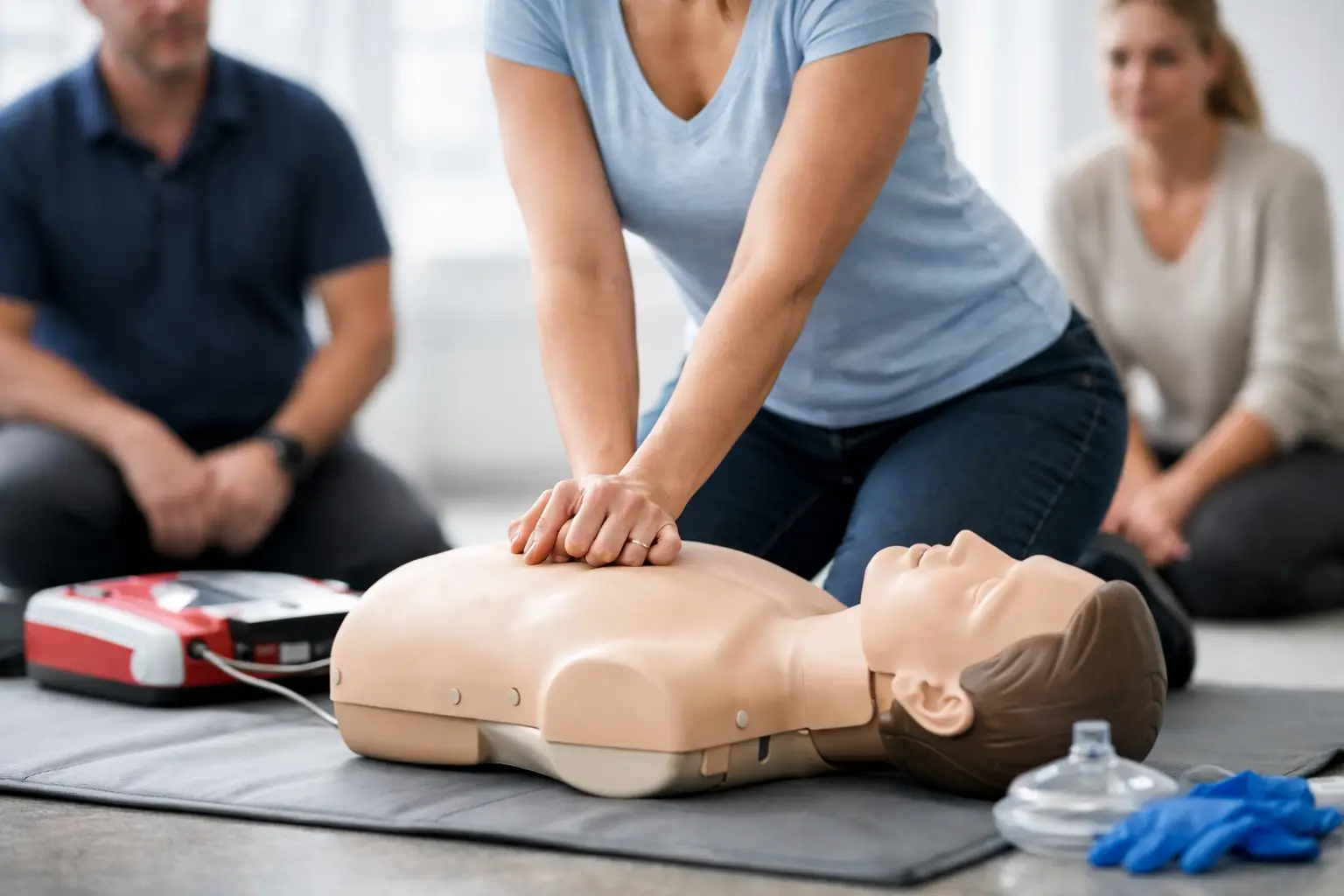
Reading about CPR is not the same as performing it. Real training asks you to recognize the emergency, call for help, start compressions correctly, and understand how an AED fits into the response. That hands-on practice is what changes behavior.
Confidence is a major reason why CPR training is important for the general public. Many emergencies happen outside hospitals, often in homes or public places. The first person on scene is usually not a physician. It may be a spouse, coworker, friend, teacher, or bystander. If that person has training, the gap between collapse and professional care becomes far less dangerous.
For workplaces, confidence has another layer. Employees need to know not only how to respond but how to coordinate. Who calls 911? Who retrieves the AED? Who meets EMS at the entrance? Training makes the response more organized and less chaotic.
For healthcare teams, confidence must be matched with precision. Basic Life Support and advanced courses support role clarity, communication, and performance standards in clinical settings. In those environments, CPR is part of a larger chain of response, but the quality of the first actions still matters.
The value of CPR training at home
Many people assume emergencies happen somewhere else. In reality, a large share of serious medical events occur at home. That makes CPR especially relevant for families, parents of young children, people caring for older adults, and households with members who have cardiac or respiratory risk factors.
Home emergencies are emotionally difficult because the person in need is often someone you know well. That emotional weight can slow action if you have no training to fall back on. CPR instruction gives family members a procedure to follow when stress is high and time is short.
The exact skills needed can vary. Adult CPR is not the same as infant or child CPR. A parent, babysitter, or childcare provider may need pediatric-focused instruction. A household with an older adult may want to be prepared for sudden collapse related to existing health conditions. Training is most useful when it matches the people you are likely to care for.
Why CPR training matters at work
A workplace emergency affects more than the individual having the event. It tests the readiness of the entire organization. Offices, warehouses, schools, retail settings, construction sites, gyms, and healthcare facilities all benefit from having staff who can respond immediately.
For employers, CPR training supports both safety culture and operational responsibility. It shows that emergency readiness is being treated as a real duty, not a policy statement. In some industries, that aligns with compliance expectations. In all industries, it reduces the likelihood that coworkers stand by helplessly while waiting for EMS.
There is a practical business case as well. Prepared teams respond faster, communicate better, and use available emergency equipment more effectively. That does not guarantee outcomes, because every event is different, but it improves the chance of meaningful intervention during the critical early minutes.
AED awareness is part of the equation
CPR training is stronger when it includes AED familiarity. An automated external defibrillator is designed to analyze heart rhythm and advise a shock when appropriate. In many cases of sudden cardiac arrest, early defibrillation is essential.
People are often intimidated by AEDs until they see how they work. Training removes that barrier. It teaches responders where the device fits into the sequence, how to use it safely, and why CPR should continue around AED prompts as instructed.
This matters in public spaces and workplaces where AEDs may already be available but underused. Having the device on the wall is not the same as having people ready to use it. Preparedness depends on both equipment and trained responders.
Training helps people act despite fear of doing it wrong
One of the biggest barriers to bystander response is fear. Some people worry about legal exposure. Others worry they will hurt the person, especially when chest compressions must be forceful. These concerns are common, but they should not keep people from learning.
A quality CPR course addresses the emotional reality of emergencies. It explains what cardiac arrest looks like, what immediate priorities are, and what effective compressions feel like in practice. It also gives context. In a true cardiac arrest, doing nothing is usually the greater risk.
There are trade-offs and real-world variables. Not every collapse is witnessed. Not every scene is safe. Not every responder has the same level of training. Some people need a community CPR class for home and workplace readiness, while others need BLS, ACLS, or PALS because their clinical role demands a higher standard of coordinated care. The right training depends on where you serve and what situations you may face.
CPR skills need refreshers
Training is not permanent just because a card is issued. Skills fade, especially if they are not used. Compression rate, depth, sequencing, and team response can all become less reliable over time without review.
That is why refreshers and recertification matter. They help people maintain muscle memory, stay current with accepted practices, and correct mistakes before a real emergency exposes them. For professionals, that supports job performance and credential requirements. For the public, it keeps lifesaving skills practical rather than theoretical.
Organizations that treat CPR training as ongoing readiness, not a one-time event, are usually better prepared. The same is true for families. A class taken years ago may still offer some confidence, but recent practice is better than relying on memory alone.
Who should consider CPR training?
The short answer is almost everyone, but the reasons differ by role. Parents and grandparents want to protect the people closest to them. Teachers, coaches, and childcare providers may be responsible for children in dynamic environments. Employers want safer workplaces and more capable teams. Healthcare professionals need performance-based training that supports patient care standards.
This broad relevance is one reason Community Responders LLC serves both public and professional audiences. The need is not limited to one setting. Emergencies happen in homes, schools, workplaces, clinics, gyms, and public spaces across communities. The response is strongest when more people know how to step in effectively.
A skill that strengthens the whole community
CPR training does more than prepare one individual. It raises the readiness of the people around them. A trained parent may protect a family member. A trained employee may save a coworker. A trained medical assistant may stabilize a patient until the full team responds. Every trained responder increases the odds that someone nearby can act before it is too late.
That community impact is often overlooked. People sign up for CPR because of a job requirement, a new baby, or a general sense of responsibility. What they gain is broader than expected. They become part of the safety net other people depend on during the worst minutes of an emergency.
If you have ever wondered whether learning CPR is worth the time, think about the alternative. Emergencies rarely wait for the perfect person to arrive. More often, they depend on whoever is already there, ready or not. Training gives you a better answer when that moment comes.