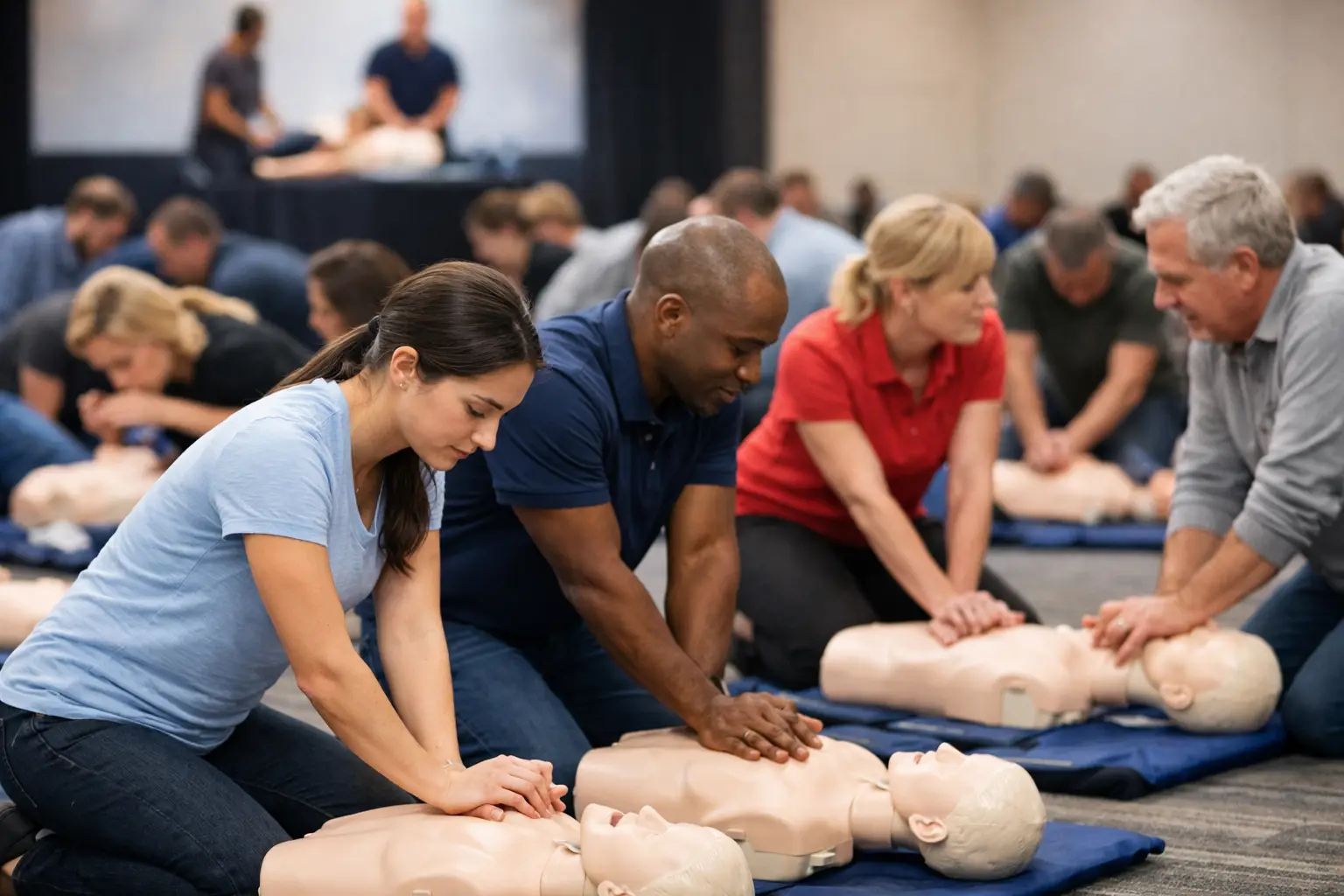
A packed gym, a school cafeteria, a warehouse break room, a hospital education lab - mass CPR training 2026 is not just about getting more people into seats. It is about making sure large groups leave ready to act when a real emergency unfolds in front of them.
That distinction matters. A large attendance number can look impressive on paper, but CPR training only has value when people can recognize cardiac arrest, start compressions fast, use an AED correctly, and keep going until EMS arrives. In 2026, the organizations that get this right will treat scale and skill as equal priorities.
Why mass CPR training 2026 needs a different approach
Traditional small-group CPR classes still matter. They give instructors time to correct hand placement, compression depth, and pacing in a more controlled setting. But mass training serves a different purpose. It is designed to raise the number of capable responders across a workplace, campus, community, or health system in a short period of time.
That creates clear advantages. More trained people means a better chance that someone nearby can respond in the first critical minutes. It can strengthen workplace readiness, improve public confidence, and support broader safety goals. For schools, employers, and community organizations, it also sends a serious message about responsibility rather than checking a box.
The trade-off is obvious. As class size grows, personal coaching becomes harder. People can hide in the crowd. Some participants will understand the sequence but still hesitate under pressure. Others may leave feeling certified without being truly prepared. That is why mass CPR training 2026 cannot be treated like an oversized version of a standard class. It needs its own training design.
What good mass CPR training looks like
The strongest large-format CPR programs are built around performance, not presentation. That means less talking, more guided repetition, and a clear focus on the exact actions a responder must take.
Participants should leave with a working response pattern: check for responsiveness, call 911 or direct someone to call, get an AED, begin hard and fast chest compressions, and follow AED prompts. If a program spends too much time on background information and not enough on physical practice, retention drops.
Good training also plans for the emotional reality of emergencies. Many untrained or lightly trained people do not fail because they forgot every step. They fail because they freeze. Large-group instruction should address that directly. Instructors need to say plainly that doing something fast is better than doing nothing while waiting for perfect confidence.
Hands-on practice remains the standard. Even in a mass setting, manikins, AED trainers, instructor observation, and correction cycles are what turn awareness into response capability. Video-led formats can help with consistency, especially across large groups, but they should support instruction rather than replace active coaching.
The skill checks that cannot be skipped
If a program is trying to move hundreds of people through training, there can be pressure to keep things fast. That is understandable, but some elements are not optional.
Participants need practice on compression rate and depth, complete chest recoil, minimizing pauses, and AED pad placement. They should also rehearse team dynamics such as switching compressors and assigning roles. In workplace or healthcare settings, those team transitions are often where delays happen.
For non-clinical audiences, the training should stay practical and plainspoken. People do not need a lecture heavy with medical language. They need to know what cardiac arrest looks like, what to do first, and how to keep moving when the scene feels chaotic.
Who benefits most from large-scale CPR programs
Mass CPR training works best when the setting already has groups of people who share space, risk, or responsibility. Schools, corporate campuses, manufacturing sites, hospitality teams, municipal agencies, churches, athletic programs, and healthcare organizations all fit that description.
In workplaces, the value goes beyond compliance. A trained workforce can respond to a collapsed coworker, visitor, contractor, or customer before EMS arrives. In community settings, broad CPR coverage creates more potential responders in everyday places such as youth events, apartment complexes, and neighborhood gatherings.
Healthcare organizations also benefit, but expectations should be higher. Clinical staff may need BLS-level performance rather than general awareness. In that case, mass delivery can still work, but it has to preserve formal skill verification and instructor oversight. Bigger groups are not a reason to lower standards.
Parents, coaches, and community volunteers are another key audience. They may never work in healthcare, but they are often present when children, older adults, or bystanders need immediate help. For them, accessible training is not a professional requirement. It is a readiness decision.
The biggest planning mistakes organizations make
The first mistake is treating attendance as the main success metric. A room full of participants means very little if too few can perform quality compressions or use an AED with confidence.
The second mistake is underestimating logistics. Mass training needs enough manikins, AED trainers, instructors, floor space, and time for rotations. If participants spend most of the session watching instead of practicing, the program loses value quickly.
The third mistake is using one format for every audience. Office staff, warehouse teams, teachers, and nurses do not all need the same depth, examples, or pace. A strong provider will adjust delivery while keeping core standards intact.
There is also a common temptation to cram CPR, first aid, emergency planning, and policy review into one oversized event. Sometimes that works. Often it dilutes the most time-sensitive skill in the room. If the goal is cardiac arrest response, protect time for repetitive CPR and AED practice.
How to evaluate a mass CPR training provider in 2026
The right question is not whether a provider can train a large crowd. Many can. The real question is whether they can do it without sacrificing skill quality.
Look for a provider that can explain instructor-to-student ratios, equipment planning, hands-on practice time, and how skills are observed. Ask how they adapt sessions for general audiences versus professional teams. Ask what happens when participants need correction, remediation, or certification-specific evaluation.
It also helps to ask about scenario design. Realistic examples improve recall. An office setting may need sudden collapse scenarios around conference rooms or lobbies. A school may need training framed around students, staff, and sporting events. A healthcare environment may need stronger emphasis on team response and device integration.
For multi-site employers or regional organizations, consistency matters. If you are scheduling sessions in cities such as Phoenix, Las Vegas, Denver, or Seattle, a provider should be able to maintain the same standards across locations rather than improvising from site to site.
Technology can help, but it is not the whole answer
In 2026, more organizations will use blended learning, digital registration, automated reminders, and training analytics to manage large programs. Those tools can improve scheduling and make renewals easier to track. They are useful, especially for employers and healthcare leaders managing compliance.
Still, technology does not replace performance under pressure. A clean dashboard does not mean someone can recognize agonal breathing. An online module does not prove a participant can deliver effective compressions on a manikin. The best programs use technology to support training operations while keeping the core experience practical and physical.
This is where disciplined instruction matters. Learners need direct feedback, repetition, and clear correction. If a provider leans too heavily on convenience, the program may be easier to organize but weaker when tested in a real emergency.
Building a CPR-ready culture after the event
One training day is a starting point, not the finish line. Organizations that take readiness seriously reinforce it after the class ends.
That can mean posting AED locations clearly, reviewing emergency activation procedures, identifying response leads, and scheduling refreshers before skills fade. Short practice touchpoints often help more than waiting for the next full renewal cycle. People remember what they rehearse.
Culture matters here. When leadership treats CPR training as part of operational safety, participation changes. Employees pay attention. Team members ask questions. People start to see emergency response as a shared responsibility instead of someone else’s job.
That shift is often the real value of mass training. It turns a scattered group of bystanders into a larger pool of potential responders. Community Responders LLC works in that space deliberately, with training built around real-world action rather than passive awareness.
What mass CPR training 2026 should deliver
Mass CPR training 2026 should produce more than completions, certificates, or good event photos. It should create faster recognition, quicker action, and better bystander response where people live, work, learn, and gather.
That standard is high, and it should be. Cardiac arrest does not pause for uncertainty, poor planning, or thin instruction. If you are organizing large-scale CPR training, choose a model that respects both the size of the audience and the seriousness of the skill. When seconds count, readiness has to be real.