A first aid kit on a wall does not mean a workplace is prepared. When an employee collapses, suffers a deep cut, or shows signs of heat illness, the real question is whether someone nearby knows what to do in the first few minutes. That is where workplace first aid requirements move from a compliance issue to a safety outcome.
For employers, supervisors, and safety leads, the challenge is that there is no single checklist that fits every setting. An office, a warehouse, a construction site, and a healthcare facility do not face the same hazards. The right approach starts with understanding what the law generally expects, then building a first aid program that matches the actual risks on site.
What workplace first aid requirements usually mean
In the US, workplace first aid requirements are typically shaped by OSHA rules, industry standards, and the hazards specific to the job. In practical terms, employers are expected to provide a reasonably safe workplace, make first aid supplies available, and ensure employees can receive prompt medical attention.
That sounds straightforward, but the details depend on the work environment. If a hospital, clinic, or emergency medical service can reach the site quickly, the first aid expectation may focus more on supplies and emergency procedures. If medical services are not readily available, employers may need trained first aid providers on site. The phrase OSHA often uses is that medical personnel must be available for advice and consultation, and when a clinic or hospital is not in near proximity, a person or persons must be adequately trained to render first aid.
The key point is that readiness is tied to response time and risk. A low-hazard office with rapid EMS access is one situation. A remote work crew, manufacturing floor, or high-heat outdoor job is another.
OSHA sets the floor, not the finish line
Many employers look for a simple pass-fail answer. The reality is more nuanced. OSHA establishes baseline expectations, but a minimum legal standard may still leave gaps during a real emergency.
For example, OSHA can require suitable first aid supplies that are readily available. It can also point to the need for trained responders when outside medical care is not close enough. But OSHA does not create the same detailed staffing formula for every industry and every workplace. That leaves employers responsible for evaluating their own hazards.
This is where many safety programs either become effective or stay superficial. If your employees work with machinery, chemicals, electrical systems, sharp tools, high temperatures, or patient care tasks, the first aid plan should reflect those exposures. A kit with adhesive bandages alone is not meaningful preparation for a setting where crush injuries, burns, or cardiac arrest are realistic possibilities.
How to assess workplace first aid needs
Before choosing training or stocking supplies, employers need a hazard assessment. This is the foundation of a credible first aid program.
Start with the obvious questions. What injuries or medical emergencies are most likely here? How many employees are on site at one time? Are they spread across floors, buildings, or job sites? How long would it take EMS to reach the injured person, not just the front entrance? Is the workday limited to business hours, or does it include nights, weekends, or solo shifts?
Then look at the less obvious issues. Heat stress, severe allergic reactions, diabetic emergencies, slips and falls, and sudden cardiac arrest happen in workplaces that do not consider themselves high risk. In offices, a medical emergency may be more likely than a machinery injury. In industrial environments, both may be realistic.
A good assessment also accounts for workforce patterns. If your designated first aid responder works one shift and leaves at 5 p.m., what happens after that? If your trained employee is out sick, is there backup coverage? Compliance can fall apart quickly when the plan depends on one person.
First aid kits are required, but they must fit the job
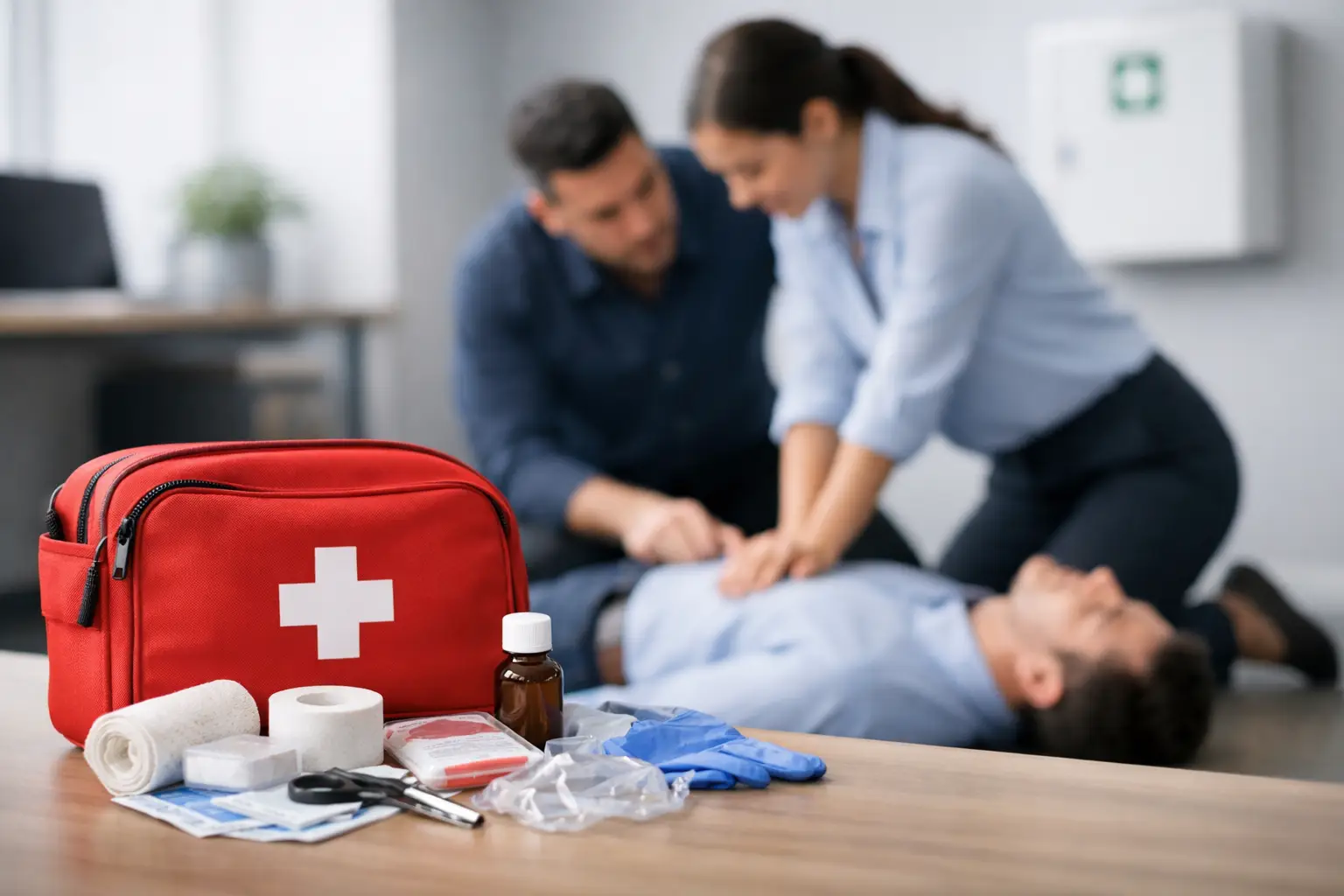
One of the most visible workplace first aid requirements is having supplies available. The mistake is treating the first aid kit as a generic purchase rather than a job-specific resource.
A compliant approach means the kit is accessible, adequately stocked, and appropriate for the hazards present. In a low-risk office, basic wound care supplies may cover most day-to-day needs. In construction, manufacturing, transportation, or maintenance settings, the kit may need more substantial items for bleeding control, burns, eye injuries, or trauma support.
Placement matters too. A fully stocked cabinet is not useful if employees cannot reach it quickly. Large facilities may need multiple kits, and mobile crews may need supplies in vehicles. The same applies to eyewash stations and other emergency equipment when exposure risks justify them.
Just as important, someone needs responsibility for inspection and restocking. Expired or missing supplies are common problems, especially in workplaces that assume the kit is fine because nobody has checked it recently.
When trained first aid personnel are necessary
A workplace does not always need a nurse, paramedic, or full-time medical staff member on site. It often does need employees who are trained well enough to act before EMS arrives.
This is especially true when the site is remote, the work is high hazard, or response delays are likely. Training should match the hazards. Standard first aid and CPR are often the baseline. Many employers also add AED training because sudden cardiac arrest can happen anywhere, and early defibrillation can change the outcome within minutes.
In some settings, bloodborne pathogens training is also necessary for employees who may provide first aid as part of their job duties. That matters because first aid response can involve exposure to blood or other potentially infectious materials. Employers should not assign response responsibilities without addressing that risk.
The strongest programs do not stop at certification cards. They emphasize skill retention, scenario practice, and clear response roles. People perform better under stress when they have practiced what to do, where equipment is located, and who calls 911.
AEDs are not always mandated, but they are often the right call
Automated external defibrillators are not universally required in every workplace, but waiting for a legal mandate misses the point. Cardiac arrest is time sensitive, and survival drops with every minute without CPR and defibrillation.
For many employers, adding an AED is a practical decision based on workforce size, age profile, public access, hazard level, and EMS response time. Large office buildings, fitness facilities, schools, warehouses, transportation hubs, and industrial sites often have strong reasons to keep AEDs accessible.
An AED program is more than buying the device. Staff need training, pads and batteries need replacement, and the device should be included in emergency drills. If you have an AED but nobody is prepared to use it, the program is unfinished.
Documentation and policy matter more than many teams expect
A workplace first aid program should exist on paper, not just in conversation. Written procedures help employers assign responsibilities, maintain consistency, and show that safety planning is active rather than assumed.
That documentation may include the hazard assessment, kit inspection records, training records, incident reporting procedures, bloodborne pathogens protocols where applicable, and emergency response steps for serious injuries or medical events. In larger organizations, it should also identify who is trained on each shift and in each area.
This is not paperwork for its own sake. During an emergency, confusion costs time. A written process helps people act faster and with less hesitation.
Common mistakes employers make
The most common failure is assuming low injury rates mean low preparedness needs. A workplace can go years without a major event and still be unprepared for the first one that matters.
Another mistake is relying on a kit without training, or training without enough people to cover all shifts. Some employers also overlook site-specific hazards. Heat illness plans are often thin in hot climates, despite the fact that outdoor crews in places like Phoenix or Las Vegas may face serious exposure for months of the year.
A more subtle problem is treating first aid as separate from the broader emergency action plan. First aid response works best when it connects to communication procedures, EMS access, building entry instructions, and post-incident reporting.
Building a program that works under pressure
The best first aid programs are practical, current, and easy to execute. They identify likely emergencies, place the right supplies where people can reach them, train enough staff to respond across shifts, and rehearse what happens before professional help arrives.
For employers who want more than bare-minimum compliance, training should be selected based on actual conditions, not generic assumptions. Community Responders LLC works with workplaces that need that kind of focused preparation, from standard first aid and CPR to higher-level response training where the environment demands it.
When seconds count, employees should not have to guess where the kit is, who is trained, or what to do first. The right first aid program gives people a clear path to act - and that clarity can make all the difference.