When someone collapses, there is no time for guesswork. People need to recognize the emergency, start care fast, and work through the right steps without freezing. That is exactly why people ask, what is BLS CPR training, and whether it is different from a standard CPR class.
BLS CPR training teaches a higher level of emergency response than basic community CPR instruction alone. BLS stands for Basic Life Support. It focuses on the immediate care used during life-threatening events such as cardiac arrest, respiratory arrest, and choking. The training is especially common for healthcare professionals, clinical staff, first responders, and workplace teams with a duty to act, but it can also be valuable for anyone who wants more structured, hands-on lifesaving preparation.
What is BLS CPR training and what does it include?
At its core, BLS CPR training teaches you how to support circulation and breathing until advanced medical care arrives. That includes high-quality chest compressions, rescue breaths, the correct use of an automated external defibrillator or AED, and team-based response during adult, child, and infant emergencies.
What separates BLS from a more basic CPR course is not just the content, but the standard of performance. In a BLS class, students are expected to apply skills with precision. The course usually emphasizes compression depth and rate, minimizing interruptions, effective ventilations, and rapid assessment. For healthcare workers, that level of detail matters because outcomes can depend on seconds, coordination, and technique.
BLS training often covers single-rescuer and multi-rescuer CPR. It also addresses bag-mask ventilation, relief of choking in responsive and unresponsive victims, and how to respond as part of a coordinated team. In many settings, this is the baseline emergency training expected before moving into more advanced courses such as ACLS or PALS.
How BLS differs from standard CPR training
This is where many people get confused. Not every CPR class is a BLS class, even if both teach chest compressions and AED use.
A standard CPR and first aid course is often designed for the general public. Parents, teachers, coaches, babysitters, and office staff commonly take these classes to prepare for emergencies at home, school, or work. The instruction is practical and accessible, with a strong focus on early recognition and immediate action.
BLS CPR training is usually more clinically structured. It is often required for nurses, medical assistants, dental professionals, EMTs, technicians, and others working in patient care environments. The material may overlap with community CPR in some areas, but BLS places greater emphasis on professional response standards, team dynamics, and airway support techniques.
That does not mean one course is better than the other in every case. It depends on your role. A parent may not need the same certification as an emergency department technician. A front office employee may only need general CPR and AED training, while a hospital employee may be required to maintain BLS certification for employment or credentialing.
Who should take BLS CPR training?
For many people, BLS is not optional. It is a job requirement. Hospitals, outpatient clinics, dental offices, surgery centers, urgent care facilities, and long-term care settings often require staff to hold a current BLS certification.
That said, BLS training is not limited to licensed clinicians. It can also make sense for childcare providers, fitness professionals, security teams, school staff, and workplace responders, especially in environments where medical emergencies are more likely or where a faster, more coordinated response is expected.
If you are unsure which class fits your situation, start with the question of responsibility. Are you learning for general preparedness, or are you expected to respond as part of your professional role? If your employer, licensing board, or school program specifies BLS, then a standard CPR class may not meet the requirement.
What happens during a BLS CPR training course?
A quality BLS course is hands-on. Students do not just listen to information. They practice skills repeatedly so they can perform them under pressure.
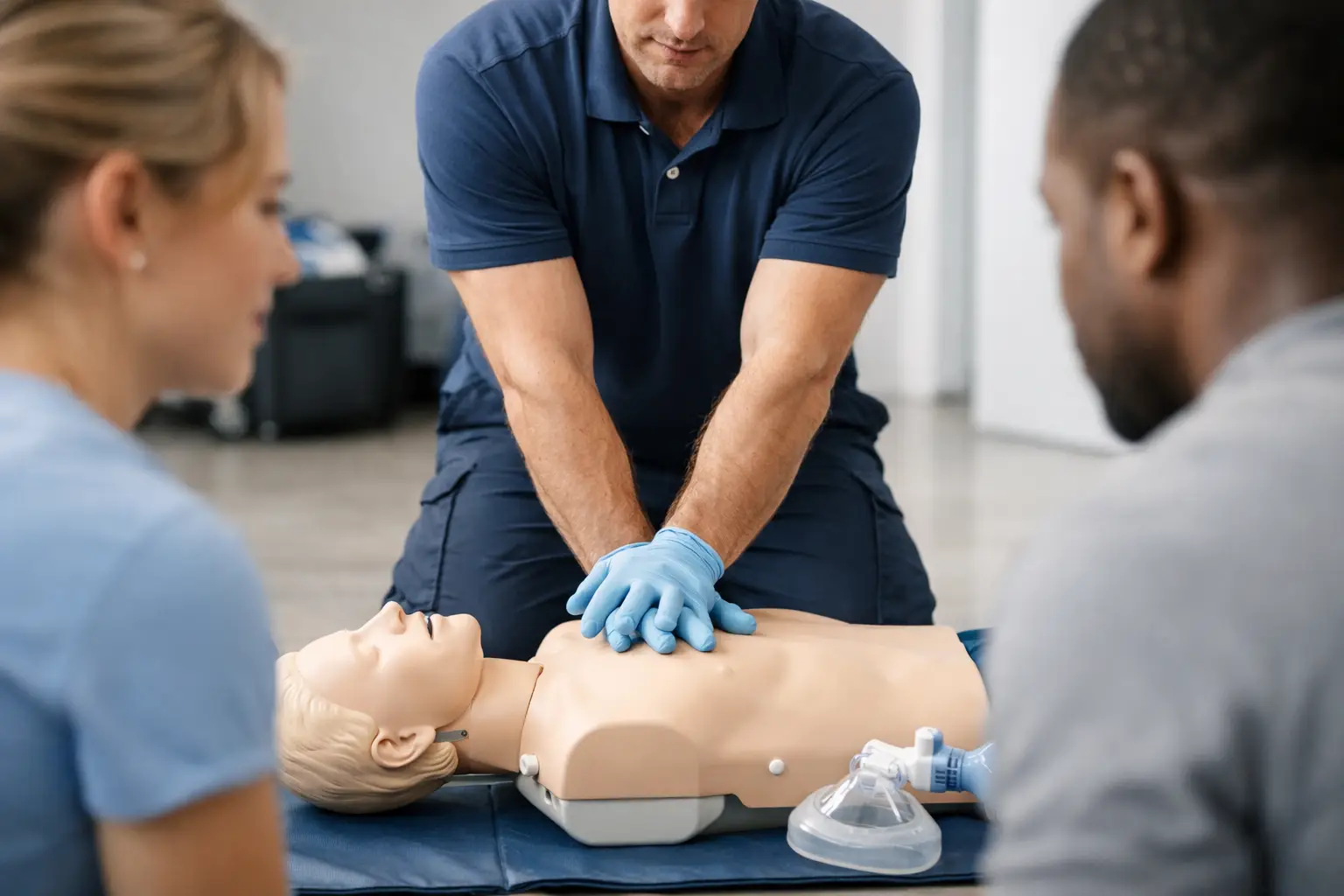
Most BLS classes include instructor-led demonstrations, guided practice on manikins, AED use, and scenario-based testing. Students learn how to assess the scene, confirm unresponsiveness, activate emergency response systems, begin CPR, and continue care efficiently until help arrives.
Many courses also include skills checks and a written exam. This is one reason people often find BLS more demanding than a general CPR course. The goal is not simply exposure to the material. The goal is proven competence.
Instructors typically correct details that matter in real emergencies, such as hand placement, compression recoil, ventilation timing, and role assignment during team response. Those details can feel small in class. They are not small when a real person is not breathing.
Why BLS training matters in real emergencies
Cardiac arrest is unforgiving. Survival drops quickly when CPR is delayed or performed poorly. Good training improves the odds that someone nearby can recognize the problem, start care immediately, and use an AED without hesitation.
That matters in hospitals and clinics, but it also matters in schools, workplaces, gyms, airports, churches, and homes. Emergencies do not wait for ideal conditions. They happen in crowded rooms, during routine appointments, on sidewalks, and in front of family members who never expected to be the person who had to act.
BLS CPR training helps reduce hesitation. It replaces panic with a sequence. Check responsiveness. Call for help. Start compressions. Use the AED. Support breathing. Work as a team if others are available. People still feel stress in emergencies, but training gives them something solid to follow.
For employers, this kind of preparedness can also support workplace safety and compliance. For healthcare professionals, it protects both patients and professional standards. For community members, it can mean the difference between standing by and stepping in.
What to look for in a BLS CPR training program
Not all training experiences are equal. If you need BLS certification, make sure the course meets the standards required by your employer, school, or credentialing body. This is one area where assumptions cause problems. A class that sounds similar may not be accepted for your role.
Beyond certification acceptance, the quality of instruction matters. Good BLS training should be practical, structured, and skills-focused. Students should leave knowing not only what to do, but how to do it correctly and confidently. That means enough hands-on time, clear coaching, and realistic scenarios.
It also helps to choose a training provider that works with both community learners and professionals. A company like Community Responders LLC understands that the person taking BLS may be a nurse, a dental assistant, a school employee, or someone preparing for a healthcare career. The teaching should respect the seriousness of the material while still making it approachable.
How often do you need to renew BLS?
BLS certification is not permanent. Most providers require renewal on a regular cycle, often every two years, though your employer or licensing organization may set stricter expectations.
Renewal matters because CPR standards can change, and skills fade when they are not practiced. Even experienced professionals benefit from retraining. In emergencies, people do not rise to the level of intention. They fall back on what they have practiced.
If your certification is close to expiring, do not wait until the last minute. Scheduling early gives you more options and lowers the risk of a lapse that could affect your job, clinical placement, or workplace compliance.
Is BLS CPR training worth it if you are not a healthcare professional?
In many cases, yes. If you are responsible for others, work in a high-contact environment, or simply want stronger emergency response skills, BLS can be a smart investment. It offers a more rigorous level of preparation than many entry-level CPR courses.
Still, more advanced is not automatically more appropriate. Some people are better served by a CPR and first aid class that matches the situations they are most likely to face. The best course is the one that fits your actual responsibilities and gives you the confidence to act.
Readiness is not about collecting certifications. It is about being able to respond when a life depends on it. If BLS is the right fit for your role, treat it as more than a requirement. Treat it as practice for the moment that will ask you to stay calm, move fast, and do the next right thing.