Someone collapses. They are not responding. They are not breathing normally. In that moment, knowing how to use an AED can help turn bystanders into lifesavers.
An automated external defibrillator, or AED, is designed to be used by ordinary people as well as trained responders. It gives voice prompts, visual instructions, and only delivers a shock if the heart rhythm is one that can be treated with defibrillation. That matters, because sudden cardiac arrest is a time-critical emergency. CPR keeps blood moving. An AED may restore a shockable rhythm. Used together, they give the person the best chance of survival before EMS arrives.
What an AED actually does
An AED does not restart every stopped heart, and it does not replace CPR. It analyzes the heart's rhythm and determines whether a shock is advised. If the device says no shock is advised, you still continue care as directed, usually with CPR until help takes over or the person begins to respond.
This is where many people hesitate. They worry about doing harm, pressing the wrong button, or using the machine incorrectly. In practice, AEDs are built to reduce those risks. They walk you through the process step by step. Your job is to act quickly, follow the prompts, and avoid unnecessary delays.
When to use an AED
Use an AED when a person is unresponsive and not breathing normally. Occasional gasping is not normal breathing. If you are unsure, treat it as cardiac arrest until proven otherwise.
Before anything else, make sure the scene is reasonably safe. Then check responsiveness, call 911 or direct someone specific to call, and send someone to get the AED if one is available nearby. If you are alone with an adult, call 911, get the AED if it is close, and begin CPR as soon as possible.
If the person is breathing normally and has a pulse or clear signs of circulation, an AED is not the first step. Monitor them closely and wait for EMS. The key is matching the device to the emergency, not using it automatically in every collapse.
How to use an AED step by step
The basic process is straightforward, and speed matters more than perfection.
First, turn on the AED. Most devices have a clear power button, and some turn on when the lid is opened. Once powered on, the unit begins giving voice prompts. Follow them exactly.
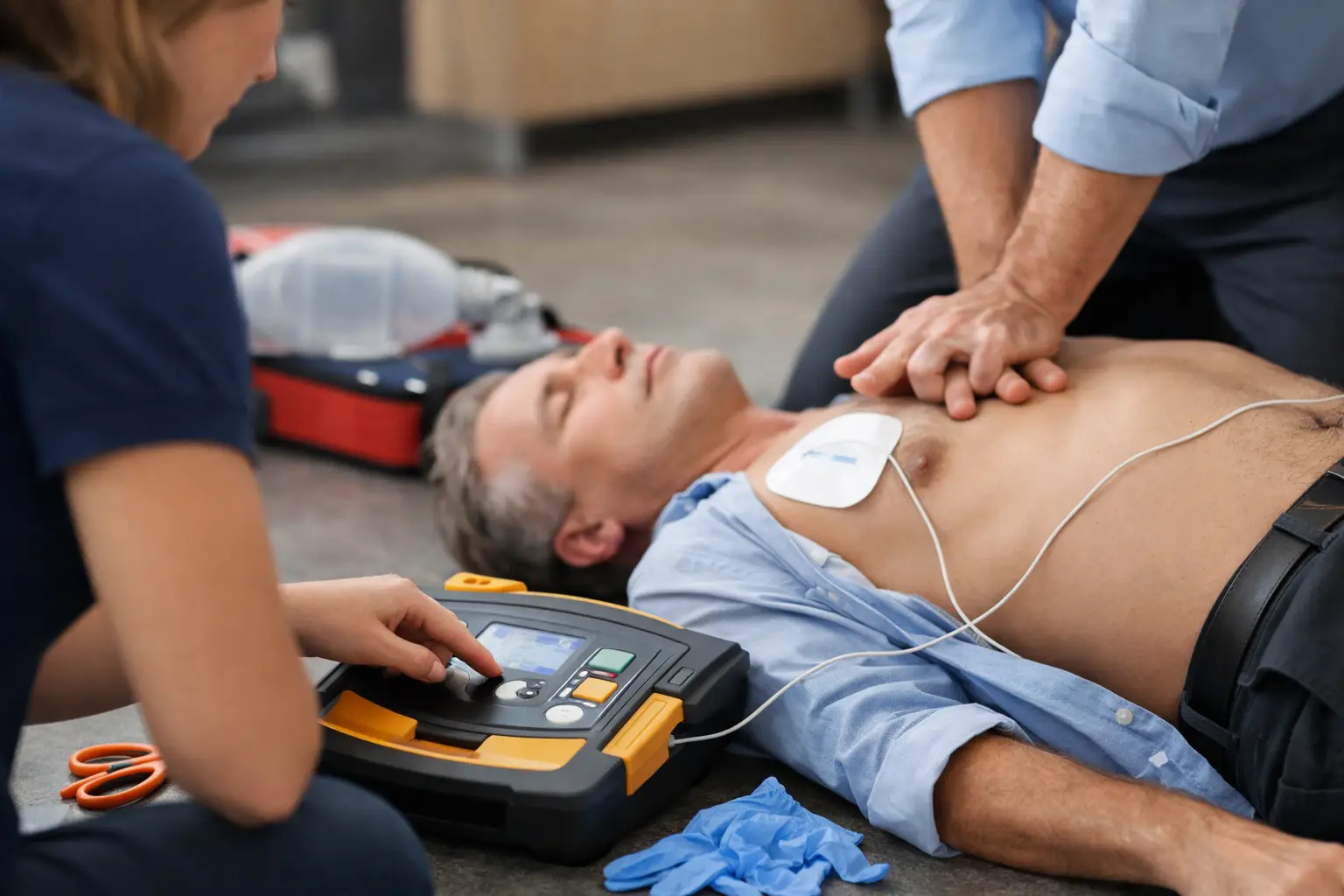
Next, expose the person's chest. Remove or cut away clothing as needed so the pads can stick directly to bare skin. If the chest is wet, dry it quickly. If there is a medication patch where a pad needs to go, remove the patch while protecting your hand, then wipe the area. If the chest is very hairy and the pads will not adhere, use a razor from the AED kit if available and shave only the pad placement area.
Apply the pads as shown on the diagrams. For most adults, one pad goes on the upper right chest and the other on the lower left side of the chest, below the armpit. Press them down firmly so they make full contact.
Once the pads are attached, the AED will analyze the rhythm. At this point, no one should touch the person. Say clearly, "Clear," look to make sure nobody is making contact, and allow the machine to analyze.
If the AED says a shock is advised, make sure everyone is clear again. Then press the shock button if the device requires it. Some AEDs deliver the shock automatically after warning prompts. As soon as the shock is delivered, resume CPR immediately, starting with chest compressions.
If the AED says no shock is advised, resume CPR right away unless the person is showing clear signs of life. The machine will reanalyze at set intervals. Keep following the prompts until EMS arrives, another trained responder takes over, or the person begins breathing normally and responding.
How to use an AED with CPR
Knowing how to use an AED also means understanding where it fits into the full response. The best practice is not AED instead of CPR. It is AED plus CPR, used without delay.
If there are two rescuers, one person starts compressions while the other gets the AED, calls 911, and prepares the pads. This team approach saves time. If you are alone, begin the chain of survival as quickly as possible and minimize interruptions in chest compressions.
After any shock, go straight back to CPR. Do not pause to check for a pulse unless the person clearly starts moving, speaking, or breathing normally. Continuous care is what carries the person through the minutes before advanced help arrives.
AED pad placement for adults, children, and infants
For adults, use standard adult pads in the usual upper-right and lower-left chest positions.
For children, use pediatric pads if they are available and if the device is designed for pediatric use. Many AEDs have a pediatric key or setting that reduces the energy level. If the child is small and the pads might touch each other on the chest, place one pad on the center of the chest and the other on the back between the shoulder blades.
For infants, follow the device instructions and your training. Many public-access AEDs can be used for infants with pediatric capability, but the exact setup depends on the manufacturer and pad type. If pediatric pads are not available, some guidelines allow the use of adult pads if they do not overlap. This is one of those situations where training matters, because pad placement and device options can vary.
Common mistakes when using an AED
The most common problem is delay. People wait because they are afraid of making a mistake. In a cardiac arrest, waiting is usually the bigger mistake.
Another issue is poor pad contact. Sweat, water, excessive hair, or clothing between the pad and the skin can interfere with analysis or shock delivery. Taking a few seconds to prepare the chest correctly improves the device's performance.
Touching the person during analysis is another avoidable error. It can interfere with the reading. The same applies during shock delivery. Make eye contact with others, say "Clear" in a firm voice, and confirm nobody is touching the patient, the bed, or any conductive surface connected to them.
There are also environment-specific concerns. If the person is lying in water, move them to a dry area first. If oxygen is in use, follow the AED prompts and standard safety precautions, keeping oxygen away from the chest during shock delivery as directed by training and device guidance.
What if the person has a pacemaker or a medical patch?
If you see a visible pacemaker or implanted defibrillator, usually a small bulge under the skin near the upper chest, do not place the pad directly over it. Place the pad at least an inch away if possible and follow the diagram as closely as you can.
If there is a medication patch where the pad should go, remove the patch and wipe the skin before applying the pad. Do not place a pad on top of the patch.
These adjustments matter, but they should not slow you down more than necessary. The goal is still rapid defibrillation with proper pad contact.
Why training still matters if AEDs are easy to use
AEDs are intentionally simple, but real emergencies are not always simple. You may be dealing with a crowded workplace, a panicked family member, a child instead of an adult, or an uncertain collapse where you need to decide fast. Training helps you recognize cardiac arrest sooner, start high-quality CPR faster, and use the AED without losing time.
That is why formal instruction remains valuable for families, teachers, coaches, workplaces, and healthcare teams. At Community Responders LLC, the focus is not just passing a class. It is building the kind of response habits people can rely on when the pressure is real.
How to be ready before an emergency happens
If your home, workplace, school, gym, or church has an AED, make sure people know where it is. Check that the battery and pads are within date and that the device is accessible, not locked away behind layers of delay. A working AED that nobody can find is not much help.
It also helps to think through roles ahead of time. In a workplace, who calls 911, who brings the AED, and who starts CPR? In a youth sports setting, who meets EMS at the entrance? These small planning steps reduce confusion and buy time when seconds count.
You do not need to be a paramedic to save a life. You need to recognize the emergency, start CPR, use the AED, and keep going until help arrives. The best time to make that process familiar is before you ever need it.