A person collapses without warning, and the room changes instantly. In that moment, knowing how to perform CPR correctly is not academic - it is a practical skill that can keep blood and oxygen moving until EMS arrives.
CPR is not complicated because the steps are mysterious. It feels hard because emergencies are loud, fast, and stressful. People worry about hurting someone, freezing up, or doing it wrong. The reality is simpler and more urgent: if a person is unresponsive and not breathing normally, doing something effective now is far better than waiting for perfect conditions.
How to perform CPR correctly in the first seconds
Start by making sure the scene is safe for you and the person in distress. If there is active traffic, fire, exposed electricity, or another immediate hazard, do not rush in blindly. Once it is safe, tap the person and shout. If they do not respond and they are not breathing or only gasping, call 911 or direct a specific bystander to call and get an AED.
That last step matters. Many people yell, “Someone call 911,” and everyone assumes another person will handle it. Point to one person and give a direct instruction. If you are alone with an adult, call 911, put the phone on speaker if possible, and begin CPR immediately. If an AED is nearby, use it as soon as it arrives.
Normal breathing is the key distinction here. Occasional gasps, choking-like sounds, or irregular breaths are not normal breathing. Cardiac arrest can present with agonal gasps, and bystanders sometimes mistake that for life. If the person is unresponsive and not breathing normally, treat it as cardiac arrest.
Adult CPR step by step
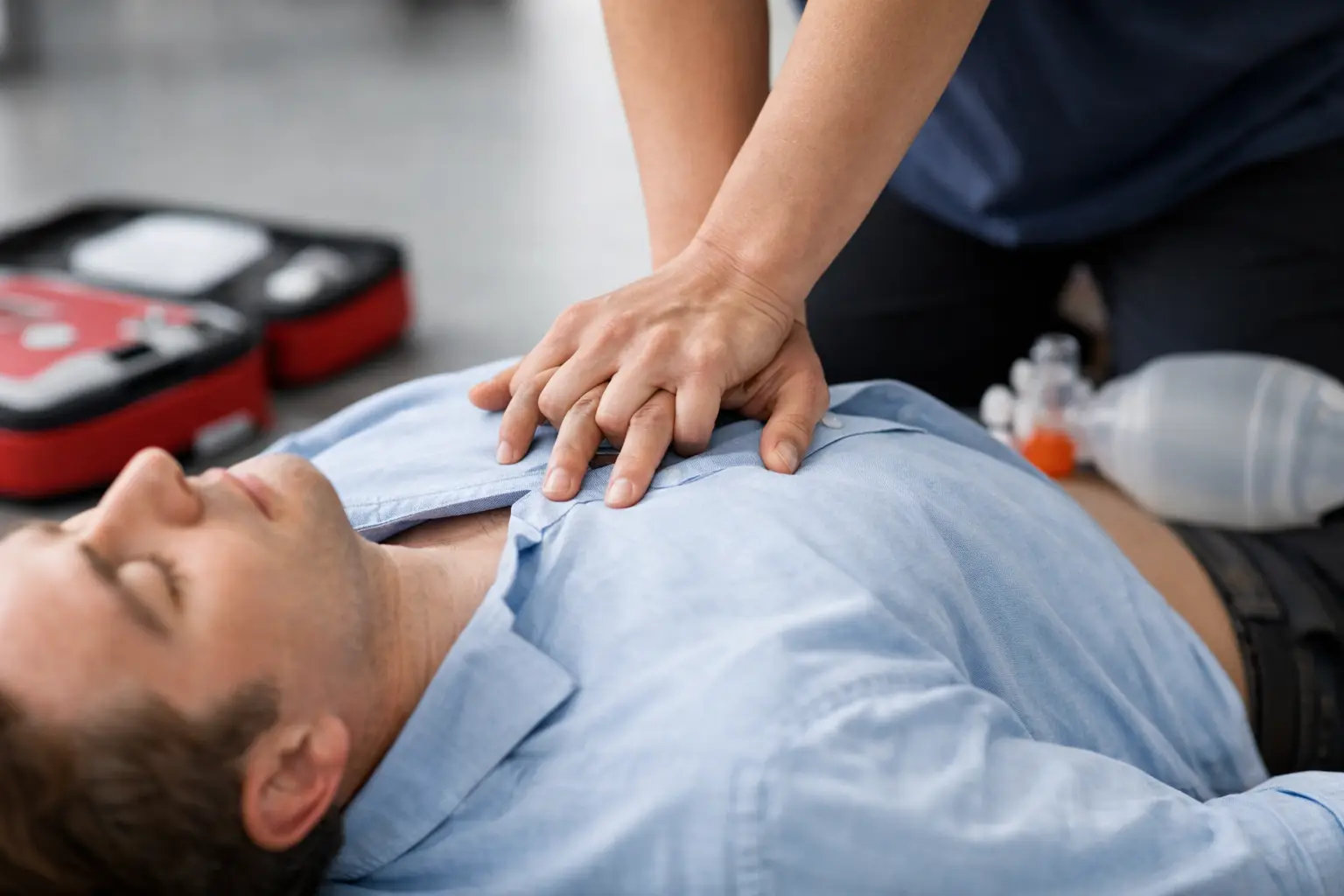
Place the person flat on their back on a firm surface. Kneel beside the chest and put the heel of one hand on the center of the chest, on the lower half of the breastbone. Place your other hand on top and lock your elbows so your shoulders are directly over your hands.
Push hard and fast. For an adult, chest compressions should be at least 2 inches deep, at a rate of 100 to 120 compressions per minute. Let the chest come all the way back up after each push. That recoil is not a small detail - the heart needs that release phase to refill with blood.
If you are trained and willing to give breaths, use a 30:2 pattern. After 30 compressions, open the airway with a head-tilt, chin-lift, pinch the nose, and give 2 breaths. Each breath should last about 1 second and make the chest visibly rise. Then return to compressions right away.
If you are not trained in rescue breaths, or if you are unwilling to give them, perform hands-only CPR. Continuous chest compressions can still make a critical difference, especially in the first minutes of adult sudden cardiac arrest.
Keep going until one of four things happens: an AED tells you to stop for analysis, EMS takes over, the person clearly shows signs of life, or you are physically unable to continue.
Using an AED with CPR
An AED is designed for ordinary people to use under pressure. Turn it on and follow the voice prompts. Expose the chest, dry it if needed, and attach the pads exactly as shown on the pad diagrams. One pad usually goes on the upper right chest and the other on the lower left side.
When the AED says to stand clear, make sure no one is touching the person. If a shock is advised, deliver it, then restart CPR immediately. Do not pause to check for a pulse unless you are specifically trained and the situation requires it. In most community response settings, minimizing interruptions is the priority.
There are a few practical exceptions. If the chest is very hairy, pad adhesion can be poor. If the person has a medication patch where a pad needs to go, remove the patch with a gloved hand if available and wipe the area. If they have an implanted device such as a pacemaker, place the pad slightly away from the visible bump rather than directly over it.
Child and infant CPR is different
Children and infants are not just smaller adults. Cardiac arrest in younger patients is often related to breathing problems, which is why rescue breaths matter even more.
For a child, use the heel of one or two hands depending on the size of the child. Compress about 2 inches deep, or roughly one-third the depth of the chest. For an infant, use 2 fingers if you are alone, or the two-thumb encircling technique if there are two rescuers, and compress about 1.5 inches deep, again around one-third the depth of the chest.
The rate stays at 100 to 120 compressions per minute. If you are alone and the collapse was not witnessed, provide about 2 minutes of CPR before leaving to call 911 and get an AED, if no phone is already available. If you witness the collapse, call 911 and get the AED first, then start CPR.
For both children and infants, use 30 compressions to 2 breaths if you are alone. If there are two trained rescuers, the ratio is often 15 compressions to 2 breaths. Breaths should be gentle - just enough to make the chest rise. Too much air can be harmful and can delay compressions.
Common mistakes when trying to perform CPR correctly
The most common problem is hesitation. People spend too long checking for signs of life, looking for a pulse they are not trained to assess, or hoping the person will wake up on their own. CPR works best when it starts early.
Another frequent issue is shallow compressions. In a real emergency, people almost always compress too softly, not too hard. You may break a rib. That is serious, but it is not a reason to avoid lifesaving care in cardiac arrest.
Fast but inconsistent compressions are also a problem. The goal is not random force. It is steady, full-depth compressions with full recoil at a controlled pace. Interruptions should be as short as possible, especially around breaths, rhythm checks, and AED use.
Poor hand placement can reduce effectiveness. So can bending your elbows and using arm strength instead of body weight. Good CPR is mechanical in the best sense - proper position, repeated accurately under pressure.
When rescue breaths matter most
Hands-only CPR is appropriate and strongly encouraged for many adult sudden collapses, especially for untrained bystanders. But there are situations where adding breaths is particularly important: drowning, drug overdose, respiratory arrest, children, and infants.
That is where training changes outcomes. A short, practical class gives people a chance to practice airway positioning, breath delivery, compression depth, and AED use before the stress of a real event. Community Responders LLC teaches these skills with the kind of repetition that builds useful confidence, not false confidence.
CPR safety and what to do after
If you have gloves or a barrier device, use them. If not, do not let the lack of equipment stop you from starting compressions. Your first responsibility is rapid action. For bystanders, hands-only CPR remains a strong option when barrier protection is not available.
After EMS arrives, give a brief, clear handoff. Say when the person collapsed if known, when CPR started, whether an AED was used, how many shocks were delivered, and any details you observed such as drowning, choking, or overdose concerns. This helps the next level of care move faster.
You should also expect a response from your own body afterward. Shaking, nausea, emotional numbness, and second-guessing are all common. Acting in a crisis is physically and mentally intense. If you were involved in a real resuscitation attempt at work, school, or in your community, a short debrief is often worthwhile.
How to perform CPR correctly before an emergency happens
The best time to improve CPR performance is before you need it. Reading helps, but CPR is a hands-on skill. Compression depth, rate, recoil, and airway technique are hard to judge without practice. Even healthcare workers need regular refreshers because skill quality declines over time.
If you are a parent, caregiver, teacher, coach, or workplace team member, training is not just a certification box. It is preparation for the few minutes that matter most. And if you work in a clinical setting, structured BLS and advanced training matter because the standard is higher and the response environment is more complex.
No article can replace live instruction, but it can make the first decision easier. If someone is unresponsive and not breathing normally, call 911, start compressions, use an AED as soon as possible, and keep going until help takes over. The right action, taken fast, is what gives a person a chance.