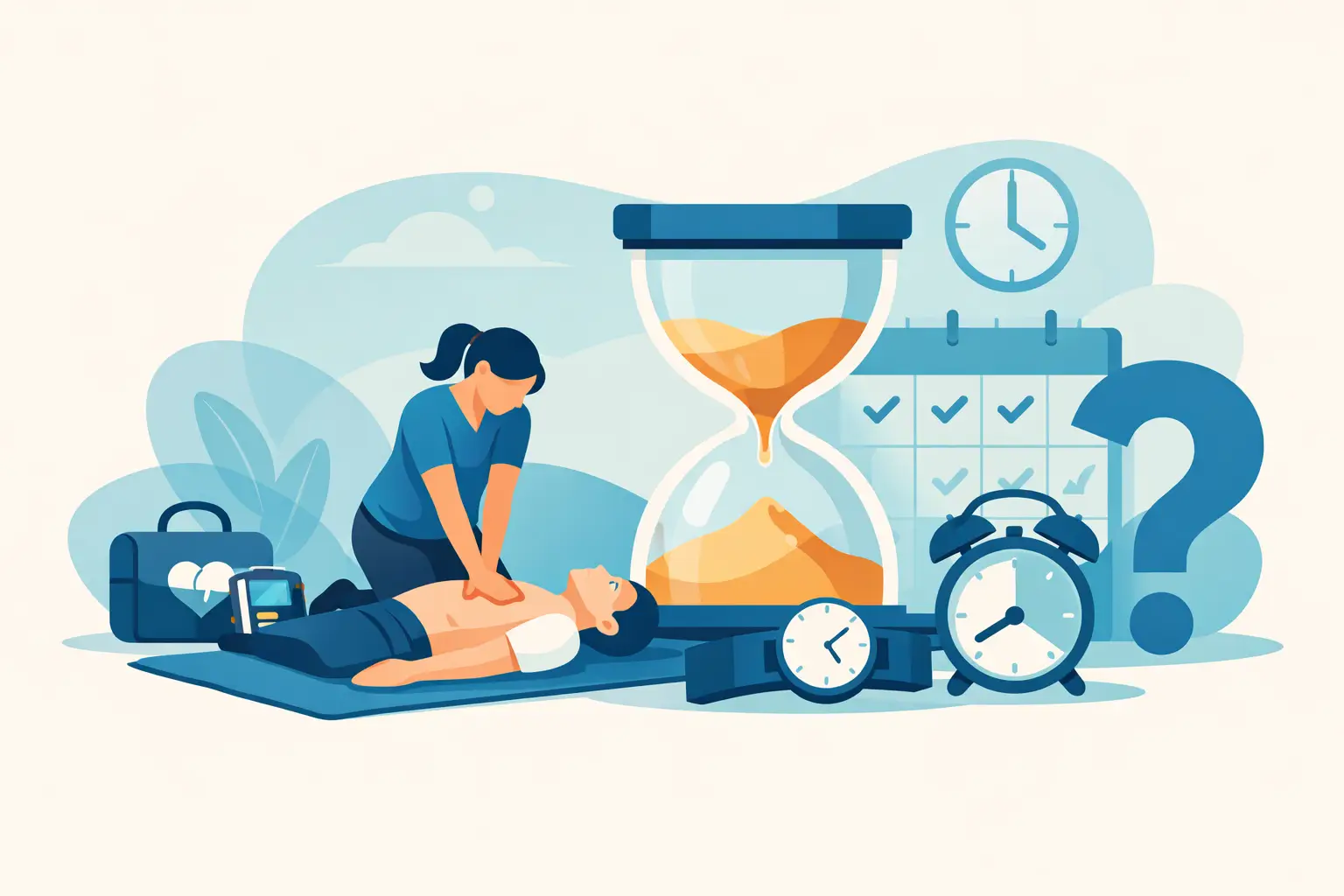
When someone asks how long is CPR training, they usually need the answer for a real reason - a job deadline, a childcare requirement, a workplace safety plan, or the simple need to be ready before an emergency happens. The short answer is that most CPR classes take between 2 and 5 hours, but the true length depends on the type of course, whether it includes first aid, and whether it is designed for the public or for healthcare professionals.
That range matters because not all CPR training serves the same purpose. A parent learning infant CPR does not need the same depth as a nurse renewing Basic Life Support. A workplace safety course has different goals than an ACLS class for clinical teams. The right question is not only how long the class lasts, but what level of response you need to be prepared for.
How long is CPR training for most people?
For the general public, CPR training is usually one of the shorter health and safety classes available. A basic adult, child, and infant CPR course often runs about 2 to 4 hours. If the course also includes AED use, that generally stays within the same range because AED instruction is a standard part of many CPR programs.
If first aid is added, the class usually becomes longer. A combined CPR and first aid course commonly takes 4 to 6 hours. That extra time covers bleeding control, choking, burns, shock, and other common emergencies that may happen before EMS arrives.
For many learners, this is the most practical option. It gives broader emergency response training without requiring an all-day commitment in every case. Still, class length varies by provider, teaching format, and the amount of hands-on practice built into the session.
Course type changes the timeline
The biggest factor in training length is the course level.
A community CPR class is usually designed for adults with no medical background. Instruction is straightforward, focused on recognition, compressions, rescue breathing when applicable, choking response, and AED use. These classes move efficiently because they are built around immediate action, not advanced medical decision-making.
BLS courses take longer because they are meant for healthcare providers and professional responders. Basic Life Support training often lasts around 3 to 4.5 hours for an initial class, though some sessions may run longer. BLS includes team response, higher-performance resuscitation concepts, bag-mask ventilation, and more structured skills testing.
ACLS and PALS are significantly longer. These are advanced courses for clinicians who need to manage cardiovascular and pediatric emergencies in professional settings. Initial ACLS or PALS courses often run one to two days, while renewal classes are usually shorter. The added time reflects rhythm recognition, medication protocols, team dynamics, case scenarios, and written evaluation.
That difference is important. More hours do not just mean more information. They reflect a higher level of responsibility in the situations the learner is expected to manage.
Online, blended, and in-person formats
If you are comparing class options, format can affect both the clock time and the learning experience.
A fully in-person CPR course is often the most direct path. You arrive, complete the lesson, practice skills, test, and finish in one scheduled block. For many students, this is the clearest option because there is no separate online portion to manage.
Blended learning can reduce the amount of time spent in the classroom. In this format, you complete the cognitive portion online, then attend an in-person skills session. That can be useful for busy professionals or employers trying to schedule multiple staff members. However, the total training time may not be dramatically shorter. It is simply divided into separate parts.
Online-only CPR instruction may look faster, but there is a trade-off. If certification requires hands-on skills verification, a fully online course may not meet employer, licensing, or regulatory standards. That matters especially for healthcare workers, daycare staff, teachers, and workplace safety teams.
The key is to verify what your job or organization actually accepts before choosing the shortest option.
How long is CPR training if you need certification?
If you need CPR certification, the course may take a little longer than a non-certification awareness class because there is usually a formal skills check and sometimes a written assessment. Certification courses are designed to confirm that you can perform the steps, not just recognize them.
For a standard public CPR certification class, expect about 2 to 4 hours. For CPR plus first aid certification, expect closer to 4 to 6 hours. For BLS certification, many learners should plan for roughly half a day. Advanced certifications such as ACLS and PALS often require much more time, especially for first-time participants.
Renewal courses are often shorter than initial courses. That is because returning learners already understand the core concepts and need focused review, updated guidance, and skills validation. Even so, you should not assume every renewal is quick. If your certification has lapsed or your employer requires a full course, the time commitment may increase.
What actually happens during class
People sometimes picture CPR training as a lecture with a short demo at the end. A credible course should be more practical than that.
Most CPR classes include emergency scene awareness, identifying cardiac arrest, calling 911, high-quality chest compressions, AED use, and choking response. If the course includes infant or child CPR, there will also be age-specific techniques. In first aid combinations, additional time is spent on common injury and illness response.
Hands-on practice is where the training becomes useful. Learners work with manikins, follow response sequences, and practice under instructor feedback. That part takes time, and it should. In an emergency, people do not rise to the level of intention. They respond at the level of training they can actually perform under stress.
For healthcare professionals, that hands-on portion becomes even more structured. BLS, ACLS, and PALS classes often include team-based scenarios, airway management tasks, and decision-making under time pressure. That is one reason professional courses cannot be compressed too aggressively without losing value.
Why class length should not be your only decision point
It is reasonable to want the shortest course that meets your needs. Most people are balancing work, family, and deadlines. But a faster class is not automatically a better class.
A course that leaves enough time for repetition, correction, and realistic practice is usually worth more than one that rushes learners through the material. CPR is a physical skill. Timing, depth, sequence, and confidence all improve with guided repetition.
This matters even more for people who expect to use the training. Parents, coaches, teachers, security staff, childcare providers, and healthcare workers may all face moments where hesitation costs time. A few extra minutes in training can make the difference between remembering the steps and freezing under pressure.
That is why training quality, instructor credibility, and hands-on standards deserve as much attention as the class duration.
Choosing the right CPR training for your situation
The best course length depends on what you need the training to do.
If you want basic emergency readiness for home, community, or childcare situations, a 2 to 4 hour CPR class may be enough. If you want broader readiness for common emergencies, a combined CPR and first aid course is often the stronger choice. If you work in healthcare or direct patient care, BLS is typically the appropriate starting point, with ACLS or PALS required for more advanced roles.
For employers, the answer often comes down to workplace risk and compliance expectations. Offices may only need basic CPR and AED coverage. Industrial settings, schools, fitness facilities, and care environments may need more comprehensive training. The right program should match the real conditions your team may face.
Providers such as Community Responders LLC typically offer multiple course levels so learners can choose based on role, responsibility, and certification requirements rather than trying to fit every need into one class format.
A realistic time estimate before you book
If you need a practical planning number, use this as a starting point. Basic CPR usually takes 2 to 4 hours. CPR with first aid usually takes 4 to 6 hours. BLS often takes 3 to 4.5 hours. ACLS and PALS usually require one or two days for initial training, with shorter renewals when eligible.
Before you register, check four things: whether the course is for the public or healthcare providers, whether first aid is included, whether hands-on skills testing is required, and whether your employer or licensing body has specific certification standards. Those details determine whether a class is just convenient or actually useful.
When seconds count, nobody asks how fast the class was. They need someone who knows what to do and can do it without delay.