A baby can go from calm to critical in seconds. That is why first aid for infants is not abstract knowledge - it is a practical skill set that helps parents, caregivers, and anyone around a child respond with purpose instead of panic.
Infants are not small adults, and they are not even the same as older children. Their airways are smaller, their bodies lose heat faster, and signs of serious illness can be subtle at first. A response that is correct for a school-age child may be wrong for a baby under 1 year old. That difference matters when you are deciding whether to reposition, call 911, start CPR, or simply monitor and contact a pediatrician.
Why first aid for infants requires different skills
When an infant is in distress, delays often happen because adults hesitate. They worry about hurting the child, overreacting, or doing the wrong thing. The safer approach is to learn what severe problems look like before an emergency happens.
For infants, breathing and circulation issues rise to the top quickly. Choking, respiratory infections, allergic reactions, falls, burns, and fever can all become urgent faster than many caregivers expect. The goal of infant first aid is not to replace medical care. It is to recognize danger early, give immediate support, and keep the situation from getting worse while help is on the way.
Start with the first check
If something is wrong, look at the infant before you move into action. Is the baby responsive? Are they crying, coughing, breathing, or limp and quiet? Is the skin pale, blue, gray, or unusually flushed? Do you see obvious bleeding, burns, or swelling?
If the infant is unresponsive, not breathing, or only gasping, call 911 right away or have someone else call while you begin CPR. If the infant is responsive but struggling, your next step depends on the cause.
One of the most useful habits is to stay precise. A baby who is coughing forcefully is different from a baby who cannot make a sound. A fever with normal behavior is different from a fever plus lethargy, poor feeding, or trouble breathing. In emergencies, details guide decisions.
Choking is one of the most urgent infant emergencies
Choking is a leading fear for parents, and for good reason. Infants explore with their mouths, but they do not have the chewing and airway protection skills older children do.
If an infant is coughing strongly or crying, do not interfere right away. Those are signs that air is still moving. Watch closely and be ready to act if the cough weakens or the baby becomes silent.
If the infant cannot cry, cough, or breathe, support the head and neck, position the baby face down along your forearm, and deliver 5 firm back blows between the shoulder blades. Then turn the infant face up and give 5 chest thrusts using two fingers on the center of the chest, just below the nipple line. Repeat that cycle until the object comes out or the infant becomes unresponsive.
Do not perform blind finger sweeps. If you cannot clearly see the object, sweeping can push it deeper.
If the infant becomes unresponsive, begin CPR and look in the mouth only when you open the airway. If you see an object, remove it carefully.
Infant CPR: what changes under pressure
CPR for infants uses different hand placement, depth, and technique than CPR for adults. That is why hands-on training matters.
When to start CPR
Start CPR if the infant is unresponsive and not breathing normally. Gasping is not normal breathing. If you are alone, provide about 2 minutes of care first, then call 911 if no one else has already done so. If another person is present, have them call immediately and get an AED if available.
The basics of infant CPR
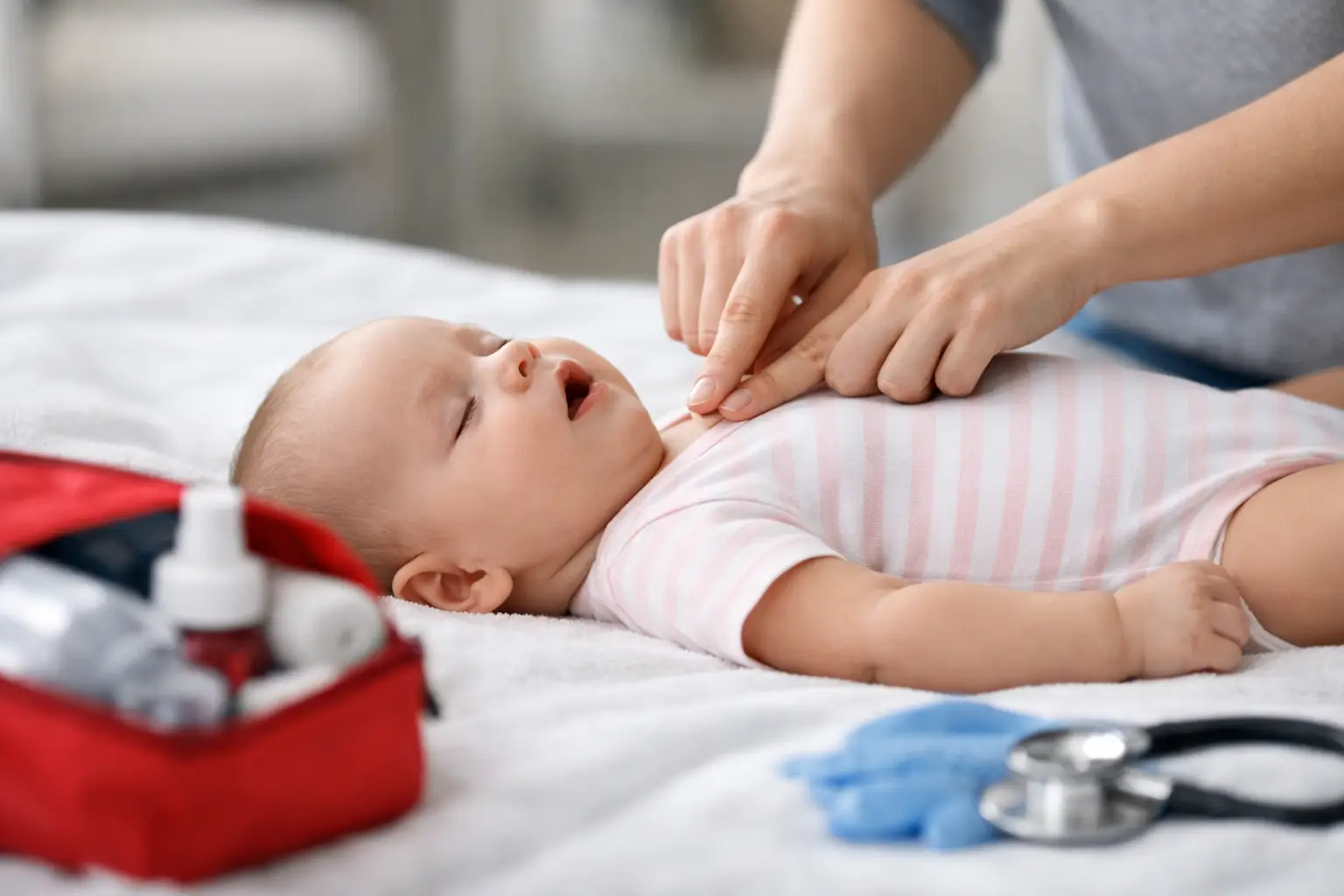
Place the infant on a firm, flat surface. Use two fingers in the center of the chest, just below the nipple line, and compress about 1.5 inches deep at a rate of 100 to 120 compressions per minute. Allow the chest to fully recoil between compressions.
For a single rescuer, give 30 compressions followed by 2 gentle rescue breaths. For two trained rescuers, the ratio is typically 15 compressions to 2 breaths. Each breath should be just enough to make the chest rise. Overventilating can do harm, especially in infants.
If an AED is available, use it as soon as possible. Follow the prompts and use pediatric pads if provided. If only adult pads are available, use them as instructed, making sure they do not touch each other.
Breathing problems can worsen quickly
Many infant emergencies begin with breathing trouble rather than sudden collapse. Watch for fast breathing, grunting, nostril flaring, retractions where the skin pulls in around the ribs or neck, poor feeding, weak crying, or blue discoloration around the lips.
If an infant has severe trouble breathing, call 911. Keep the baby in a position that supports breathing, usually upright in your arms if possible, and do not force food or fluids. If the infant stops responding or stops breathing, begin CPR.
It depends on the cause. Mild congestion may be manageable with monitoring and pediatric guidance. Labored breathing, color change, or reduced responsiveness is an emergency.
Fever, seizures, and when not to wait
Fever in infants can be routine, but age matters. In very young babies, even a moderate fever can signal serious infection.
For infants younger than 3 months, a rectal temperature of 100.4 F or higher requires prompt medical evaluation. For older infants, the concern is not just the number. It is how the child looks and acts. Poor feeding, difficulty waking, persistent crying, stiff body posture, dehydration, rash, or breathing changes raise the urgency.
If an infant has a seizure, place them on a safe surface, turn them to the side if possible, and do not put anything in the mouth. Time the seizure. Call 911 if it lasts more than 5 minutes, happens in water, follows an injury, or the infant does not recover normally afterward.
Falls and head injuries need careful judgment
Infants fall from beds, changing tables, couches, and caregivers' arms. Some falls cause minor injury. Others are more serious than they first appear.
Call 911 or seek urgent medical care if the infant loses consciousness, vomits repeatedly, has a seizure, develops abnormal breathing, cannot be consoled, acts unusually sleepy, or shows swelling or deformity of the skull. A baby who seems normal after a short fall may still need pediatric evaluation depending on age, height of the fall, and symptoms.
If there is bleeding, apply gentle pressure with a clean cloth unless you suspect a skull fracture. If the neck or spine may be injured, limit movement and wait for EMS.
Burns, cuts, and allergic reactions
For burns, cool the area with cool running water for about 10 to 20 minutes. Do not use ice, butter, or ointments as a first step. Remove tight clothing or jewelry near the burn if it comes off easily, then cover the area loosely with a clean dressing. Burns on the face, hands, feet, genitals, or large areas require urgent medical care.
For bleeding, apply direct pressure with a clean cloth or gauze. Most small cuts stop with steady pressure. If bleeding is heavy or does not stop, get emergency help.
Allergic reactions in infants can be harder to identify. Hives, vomiting, swelling of the lips or face, wheezing, or sudden breathing difficulty after feeding, medication, or insect exposure should be taken seriously. Trouble breathing or signs of shock require 911 immediately.
A first aid kit helps, but training matters more
A well-stocked infant first aid kit is useful, but supplies are not a substitute for skill. Keep a digital thermometer, bulb syringe or nasal suction tool, gauze, bandages, gloves, saline, and age-appropriate medication guidance from your pediatrician. If your child has known allergies, prescribed emergency medication should be immediately accessible.
Still, the most valuable tool is trained judgment. Knowing when to watch, when to call the pediatrician, and when to activate EMS changes outcomes.
The limits of online advice
Reading about first aid for infants is a good start, but emergencies are physical events. You need to know how hard to deliver back blows, where to place your fingers for chest compressions, and how to give rescue breaths without overdoing them. Those skills are best learned in person, with coaching and repetition.
That is where formal training earns its value. A quality infant CPR and first aid course gives you a chance to practice before the stakes are real. For families, childcare providers, and healthcare teams, that preparation turns uncertainty into action.
No one wants to imagine using infant first aid. But if that moment comes, the goal is simple: recognize the emergency, act early, and stay steady until higher care takes over. Confidence does not come from hoping nothing happens. It comes from being ready when it does.