A cardiac emergency does not wait for confidence. It happens in a kitchen, on a job site, in a clinic hallway, or during a child’s sports practice. CPR training matters because it gives people a clear response when panic would otherwise take over.
That response is not just theoretical. Good training teaches you how to recognize collapse, call for help, start chest compressions, use an AED, and continue care until EMS arrives. For some people, that means being ready at home or in the community. For others, it means meeting professional standards while staying sharp enough to perform under pressure.
What CPR training actually teaches
At its core, CPR training is about immediate action during cardiac arrest. A person’s heart has stopped pumping effectively, blood flow to the brain and vital organs is falling fast, and every minute without intervention reduces the chance of survival. The goal of CPR is to keep oxygenated blood moving until advanced care can take over.
A solid course teaches more than the hand placement for compressions. It covers scene awareness, how to assess responsiveness, when to activate emergency services, and how to identify abnormal breathing. Many untrained bystanders hesitate because they mistake gasping for normal breathing or assume someone will wake up on their own. Training reduces that hesitation.
Most programs also include AED use. That matters because CPR alone supports circulation, but defibrillation may be needed to restore a survivable heart rhythm. People often worry they will use an AED incorrectly. In practice, modern devices are designed to guide the responder step by step. Training helps remove fear and replace it with familiarity.
Why CPR training matters before an emergency happens
The value of CPR training is not measured in a classroom. It shows up later, when someone has to make a decision in seconds. Without training, many people freeze or waste time second-guessing themselves. With training, they are more likely to recognize the emergency and start care quickly.
That speed matters in every setting. At home, a spouse, parent, grandparent, or teenager may be the first person present. In workplaces, the nearest responder is often a coworker, supervisor, or safety lead. In healthcare settings, staff are expected to respond with both accuracy and urgency. The first few minutes are unforgiving, and readiness changes outcomes.
There is also a practical confidence that comes from repetition. People do not become calm in emergencies because they read about CPR once. They become more effective because they have practiced the sequence, heard realistic instruction, and corrected mistakes before those mistakes carry consequences.
Who should get CPR training
The short answer is simple: almost everyone can benefit from CPR training. The reasons differ depending on the role.
For parents, caregivers, and family members, the priority is household readiness. Emergencies involving infants, children, older adults, or relatives with medical conditions can happen without warning. Knowing what to do while waiting for EMS is not a minor skill. It is a direct way to protect the people closest to you.
For employers and workplace teams, CPR training supports safety, compliance, and business continuity. Construction sites, warehouses, offices, schools, fitness centers, hospitality settings, and public-facing businesses all benefit when staff can respond before first responders arrive. The exact training depth may vary by industry, but the need for prepared personnel is consistent.
For healthcare professionals, CPR training is part of a larger clinical responsibility. Basic Life Support may be required for many roles, while ACLS or PALS may be necessary in higher-acuity environments. In these settings, training must go beyond basic familiarity. It needs to reflect team response, current standards, and the pace of real patient care.
Not all CPR training is the same
This is where people often make the wrong choice. They assume any course will do, then find out too late that the format did not match their needs.
Some learners need community-level instruction that focuses on practical response for home, school, or public settings. Others need employer-recognized certification. Healthcare professionals may need a course aligned with job requirements and clinical expectations. Those are different use cases, and a credible training provider should make the distinction clear.
Course format matters too. Online learning can be useful for foundational concepts, but hands-on skill practice is hard to replace. Chest compression depth, rate, recoil, and AED use are physical tasks. If a course leaves learners unprepared to perform those actions on a manikin or in a simulation, the convenience may not be worth the trade-off.
The best option depends on why you are training. If your goal is basic preparedness, accessibility and clarity may be the top priorities. If your goal is credentialing or workplace readiness, you need training that meets recognized standards and prepares you for the actual demands of the role.
What to expect in a quality CPR training course
A strong course should feel structured, relevant, and realistic. You should leave knowing not only the sequence of steps, but why each step matters.
Expect instruction on adult CPR, and in many cases infant and child response as well. You may also cover choking emergencies and barrier device use. The instructor should explain how to assess the scene, reduce delays, and coordinate with 911 or an emergency response team.
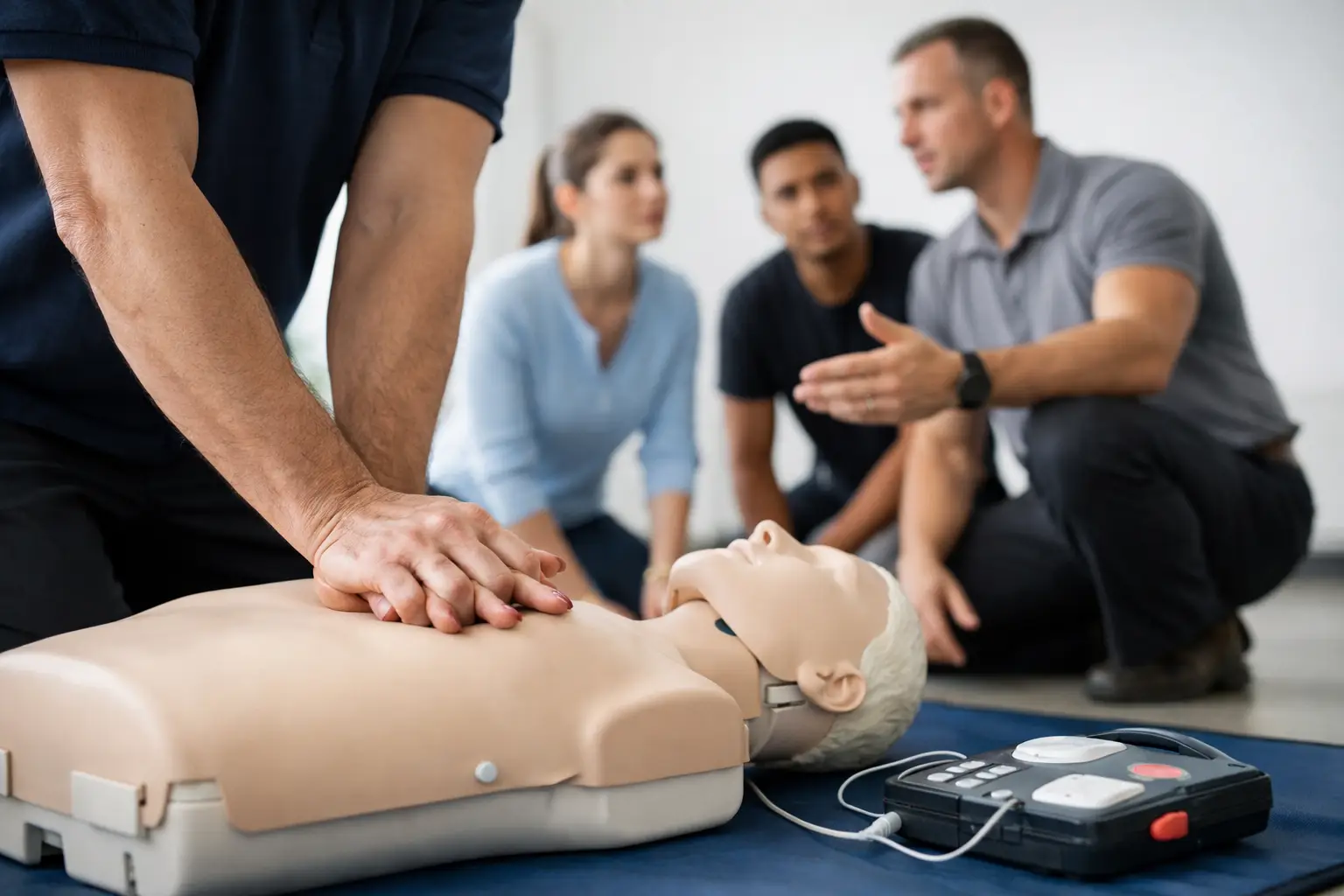
Hands-on practice is where the learning becomes durable. Learners should have time to perform compressions, use training AEDs, and work through likely scenarios. Instructors should correct technique directly. Small adjustments in hand position, compression rhythm, or body mechanics can make a major difference in performance.
A quality course also respects the reality of stress. Real emergencies are noisy, confusing, and emotionally charged. Training should address that by emphasizing simple decision points and repeatable actions. The point is not to make learners feel comfortable with every possible emergency. The point is to help them act correctly in the first critical moments.
CPR training for workplaces and professional teams
Workplace training is most effective when it matches the setting. A general office, a school, a dental practice, and an industrial site do not face identical risks, even if the core lifesaving response is the same.
Employers should think beyond a certificate on file. They should ask whether staff know where the AED is located, who calls 911, how to direct EMS on arrival, and how to maintain response capability over time. A workplace with trained employees but no clear emergency plan still has avoidable gaps.
For professional teams, consistency matters. When several staff members train together, they develop a shared language and a clearer sense of roles. That can improve performance during a real event. In cities with large and growing workforces like Phoenix, Las Vegas, Houston, or Seattle, organizations often benefit from training that can scale without losing hands-on quality.
Community Responders LLC reflects this broader need by serving both everyday learners and professional audiences. That matters because the training expectations for a parent, a teacher, and a clinician are not identical, even though all of them may one day be the first person on scene.
How often CPR training should be renewed
Skills fade faster than most people expect. Even if a certification period lasts for a set number of years, that does not mean performance remains equally sharp from start to finish.
Renewal keeps knowledge current, but more importantly, it refreshes muscle memory and decision-making. Guidelines can change. Equipment use can evolve. Your own role may shift as well. A person who originally trained for personal preparedness may later need workplace certification or more advanced instruction.
If your job requires certification, follow the required renewal timeline. If you are training for family or community readiness, it still makes sense to refresh regularly rather than waiting until you have forgotten the sequence. The goal is not just to remain technically certified. It is to remain ready.
Choosing CPR training that is worth your time
The best CPR training is training you can use. That means instruction that is credible, current, and built around real response, not passive participation.
Look for clear course descriptions, qualified instructors, practical skills work, and training that matches your role. If you are unsure what level you need, ask. A trustworthy provider should help you sort out whether you need community CPR, workplace training, BLS, or a more advanced course.
Preparedness is not about expecting the worst every day. It is about refusing to be helpless when the worst happens. The right training gives you something solid to rely on when someone’s life may depend on what you do next.