Your CPR card is about to expire, your employer is asking for updated documentation, or you simply realized it has been longer than you thought since your last class. That is usually when people start looking for a CPR certification renewal guide. The good news is that renewal is usually straightforward. The better news is that it is more than paperwork - it is a chance to rebuild skills that fade faster than most people expect.
CPR is not a set-it-and-forget-it credential. Whether you are a parent, teacher, coach, workplace responder, nurse, dental assistant, or physician, your value in an emergency depends on what you can do under pressure, not what an old card says. Renewal keeps your certification current, but more importantly, it keeps your response sharp.
When to renew CPR certification
Most CPR certifications are valid for two years, but the exact timeline depends on the issuing organization and, in some cases, employer or state requirements. If you work in healthcare, your facility may require a current BLS card at all times with no gap, even if the certifying body offers a brief grace period for registration or record updates.
That is why the safest approach is simple: do not wait until the last week. Schedule renewal at least 30 days before expiration if you need the certification for work, licensing, or clinical placement. That gives you room to handle full classes, schedule changes, or documentation issues without putting your job status at risk.
For community learners, families, and childcare providers, renewing early also makes sense because the purpose of the class is readiness. If your card lapses, your knowledge does not disappear overnight, but confidence and technique often slip long before the expiration date.
CPR certification renewal guide: what counts as renewal
A true CPR certification renewal guide has to start with one practical point: renewal is not always a separate course. In many cases, you will take the same or a very similar course as first-time students, especially if the provider wants every participant tested to the same current standard.
That can surprise people who expect a quick update class. Sometimes shorter renewal options are available, particularly for experienced professionals, but it depends on the credential, the training center, and whether any guidelines have changed since your last certification cycle.
If your card is still current, you may be eligible for a renewal-format class. If it has already expired, some providers will still accept you into a renewal course, while others will require the full course. This is one of those it-depends situations where assumptions cause delays. Always verify the policy before you register.
Choosing the right course for your role
Not every CPR class meets every need. This is where people lose time and money by signing up for the wrong course.
If you need CPR for personal preparedness, babysitting, coaching, school requirements, or workplace safety, a community CPR and first aid course may be the right fit. These classes usually focus on adult, child, and infant CPR, AED use, choking response, and basic emergency actions.
If you work in clinical care or direct patient care, you may need BLS rather than a general public CPR course. BLS usually includes a stronger focus on team response, high-quality compressions, bag-mask use, and healthcare-specific protocols. For advanced providers, ACLS or PALS renewal may also be required, but those are separate certifications with their own standards.
The key question is not, "Do I know CPR already?" It is, "What credential does my role require right now?" Employers, licensing boards, hospitals, and schools are often specific.
What to expect in a renewal class
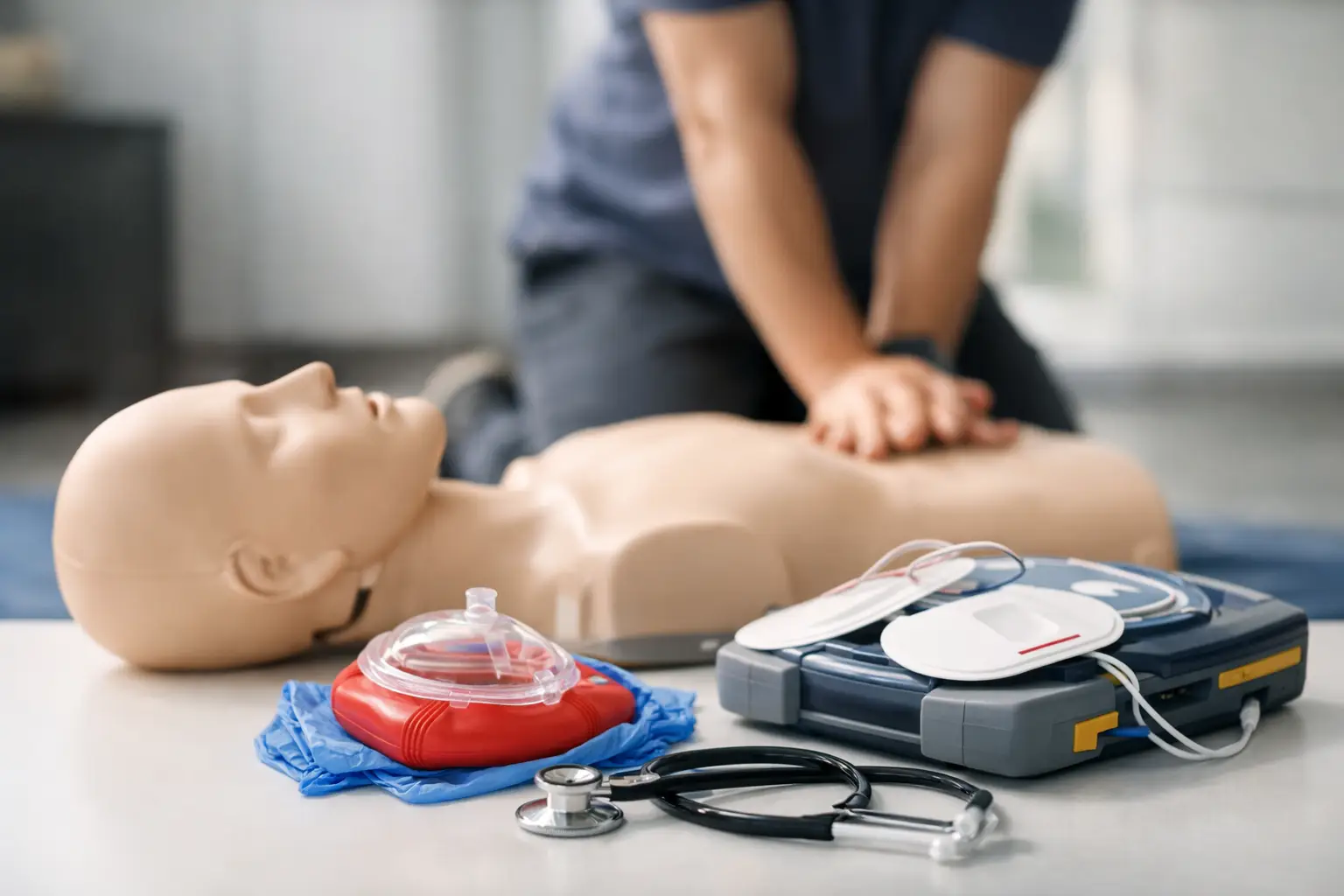
Most renewal courses cover the same core lifesaving skills that matter in real events. You should expect hands-on practice, instructor feedback, and a skills check rather than a purely passive review.
A quality class will usually include adult, child, and infant CPR techniques as appropriate to the course type, AED use, choking relief, and updates to current response standards. Professional-level classes may also include two-rescuer scenarios, ventilation techniques, and team-based response.
This matters because CPR performance is physical and procedural. Compression depth, rate, recoil, hand placement, ventilation timing, and AED confidence all benefit from repetition. People often remember the broad idea of CPR but forget the details that make it effective.
Online or blended options may also be available. These can be useful for busy schedules, especially if the cognitive portion is completed online and the hands-on skills session is done in person. For some learners, that flexibility makes renewal more realistic. For others, a fully instructor-led format provides better retention and stronger confidence. The best choice depends on your learning style and your credential requirements.
Common mistakes that delay renewal
The most common problem is waiting too long. Classes fill up, especially around compliance deadlines, and last-minute scheduling creates avoidable pressure.
The second mistake is taking the wrong course. A general CPR class may not satisfy a healthcare employer that requires BLS. Likewise, someone who only needs a community-level certification may end up paying for a course designed for clinical staff.
The third issue is assuming any online certificate will be accepted everywhere. Some employers and agencies require training from specific organizations or require an in-person skills assessment. Before you enroll, confirm acceptance with the employer, school, licensing body, or program that requested the certification.
Another common issue is treating renewal as a formality. People who walk in expecting to coast through a skills check are often surprised by how much technique they have lost. That is not failure. It is exactly why renewal exists.
How to know if your CPR skills need more than a renewal
Sometimes a standard renewal course is enough. Sometimes you need a fuller reset.
If you have not used your skills in years, feel uncertain about AED use, cannot remember infant CPR steps, or freeze when you picture a real emergency, take that seriously. You may still complete a renewal course successfully, but you should look for training that emphasizes hands-on practice and instructor correction rather than the shortest possible format.
This is especially true for workplace safety teams, childcare providers, school staff, and healthcare professionals whose response may be expected immediately. In high-stakes moments, hesitation costs time. Competence comes from recent, realistic practice.
CPR certification renewal guide for employers and teams
For employers, renewal is not just an employee checklist item. It is part of operational readiness. Offices, clinics, job sites, schools, gyms, and care facilities all benefit when trained staff maintain current certification without gaps.
The best team approach is to track expiration dates well in advance and schedule group training before a deadline becomes urgent. That reduces administrative friction and helps maintain coverage across shifts or departments. It also creates a stronger response culture because staff practice together, often in role-relevant scenarios.
This matters in fast-growing metro areas such as Phoenix, Las Vegas, Seattle, or Dallas, where large teams and busy schedules can make compliance drift if no one owns the process. A planned renewal cycle keeps training connected to real workplace risk, not just annual reminders.
What to bring and what to verify
Before class, confirm the course name, format, start time, and whether you need to complete any online modules first. Bring any required identification and, if relevant, your current certification card or proof of prior completion.
After class, verify that your name is correct on the certificate and that you know when and how the updated credential will be issued. If you need the card for employment, submit it promptly rather than assuming someone else will handle the paperwork.
If you are training with a provider such as Community Responders LLC, ask direct questions about course acceptance, hands-on components, and audience fit before booking. Good training providers expect that. Clear answers are part of credible instruction.
Why renewal matters even if you never use it
Most people who renew CPR hope they never need to perform it. That is reasonable. But the value of renewal is not measured by how often an emergency happens. It is measured by whether you can act effectively if one does.
Cardiac arrest, choking, and sudden collapse do not wait for confidence to catch up. Renewal gives you more than compliance. It gives you a recent memory of what to do, how to do it, and how to keep moving when the situation is loud, chaotic, and real.
If your certification is nearing expiration, treat renewal as part of being ready, not part of checking a box. The right class at the right time can restore confidence, correct bad habits, and make your response stronger when someone nearby needs help fast.