A medical emergency at work rarely happens on a convenient schedule. It can happen in a warehouse during a shift change, in a break room after lunch, at a front desk, on a jobsite, or during a client meeting. In those first minutes, corporate CPR training gives employees something far more useful than good intentions - it gives them a clear plan and the hands-on skill to act.
Why corporate CPR training matters at work
Most employers think about workplace safety in terms of prevention, and that makes sense. Good policies, safer equipment, and hazard controls reduce risk. But some emergencies are not preventable in the moment. Sudden cardiac arrest, choking, respiratory distress, and collapse can affect employees, customers, vendors, or visitors without warning.
That is where training changes the outcome. CPR performed quickly can sustain circulation until EMS arrives. If an AED is available and staff know how to use it, the chances of survival can improve significantly. The practical value is straightforward: trained employees are better prepared to recognize an emergency, call for help, begin care, and work together under pressure.
For many companies, the benefit is also operational. A trained team is less likely to freeze, panic, or lose time deciding who should take charge. Emergency response becomes faster, more organized, and more effective.
What good corporate CPR training should include
Not every training program prepares people equally well. Some courses check a box for compliance but leave participants unsure of what to do when a real person collapses in front of them. In a workplace setting, that gap matters.
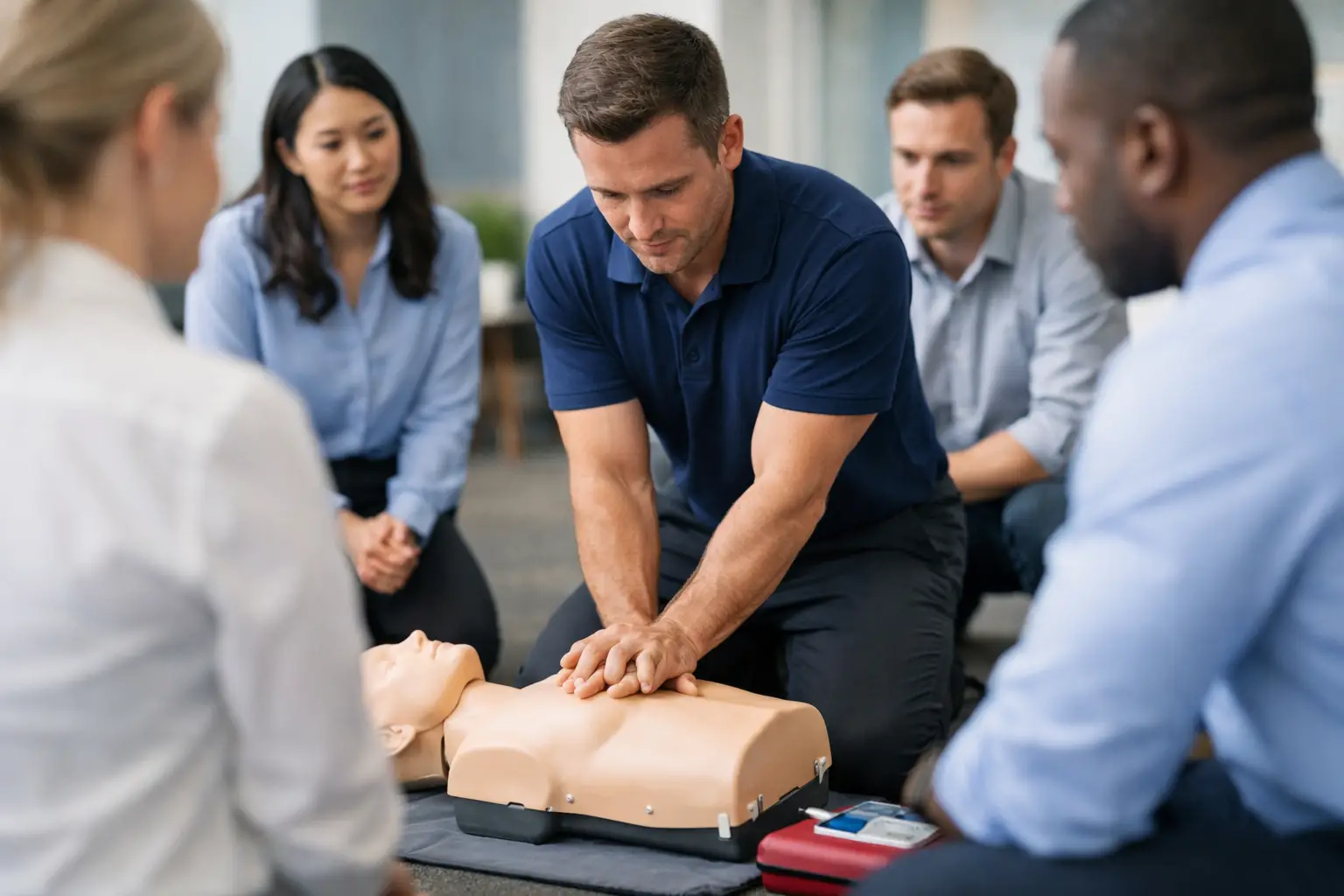
Effective corporate CPR training should be hands-on, scenario-based, and matched to the actual environment employees work in. Staff need to practice chest compressions, rescue steps where appropriate, AED use, and team response. They also need to learn how to identify cardiac arrest, what to say when calling 911, and how to manage bystanders until professional responders arrive.
The strongest programs also address realistic workplace variables. A response in an office conference room looks different from a response on a manufacturing floor, in a school setting, in a retail space, or in a healthcare facility. Training should reflect those differences instead of treating every workplace like the same room with the same risks.
Adult CPR, AED, and choking response
For most employers, this is the foundation. Employees should know how to assess the scene, recognize unresponsiveness, begin compressions, retrieve an AED, and respond to choking emergencies. These are the situations most likely to require immediate action before EMS arrives.
Team coordination under pressure
Workplace emergencies are rarely handled by one person from start to finish. Someone calls 911. Someone starts CPR. Someone retrieves the AED. Someone directs emergency responders to the correct entrance. Training works better when it reflects that team-based reality.
Certification needs versus practical readiness
Some organizations need formal certification for regulatory, policy, or industry reasons. Others mainly want emergency preparedness. Often, the right answer is both. A credible training provider should be able to meet certification requirements without reducing the course to paperwork and a pass-fail moment.
Which businesses benefit most from corporate CPR training
The short answer is almost all of them. Cardiac emergencies do not limit themselves to hospitals or high-risk industries. Any workplace with employees, customers, residents, students, or visitors can face a medical crisis.
That said, some organizations have stronger reasons to prioritize training immediately. Childcare centers, schools, fitness facilities, construction companies, hospitality teams, warehouses, property management groups, dental offices, outpatient clinics, and manufacturing employers often face a mix of public interaction, physical activity, and distributed staff. In those settings, the first trained responder is usually not a paramedic. It is a nearby coworker.
Corporate offices should not assume they are low priority. Sedentary environments, stress, underlying health conditions, and large headcounts can still create serious incidents. A polished office is not a medically controlled environment.
How to choose the right level of training
This is where many employers overcorrect in one direction or the other. Some select the shortest possible class because they want minimal disruption. Others assume everyone needs advanced clinical instruction. Neither choice is automatically right.
The appropriate level depends on workforce role, exposure, regulation, and response expectations. For many non-clinical businesses, CPR and AED training with first aid is a strong fit. For healthcare settings or teams with direct patient care responsibilities, BLS may be the proper standard. Facilities with licensed providers may need more advanced pathways such as ACLS or PALS for certain staff, but those courses serve a specific clinical purpose and should not replace basic workplace planning.
A good provider will ask practical questions before recommending a course. How many employees are on site at one time? Is the public present? Are there children, older adults, or medically vulnerable populations involved? Is an AED already installed? Are there multiple shifts or remote worksites? Those details shape the training that makes sense.
Common mistakes employers make
One of the biggest mistakes is treating training as a one-time event. Skills fade. Confidence fades faster. Employees who felt capable during class may hesitate six months later if there is no reinforcement, no emergency plan review, and no clear understanding of where equipment is located.
Another mistake is assuming that installing an AED solves the problem. An AED is valuable, but only if staff can access it quickly, use it correctly, and start CPR without delay. Equipment and training have to work together.
Employers also miss opportunities when they train too few people. Having one certified person per building sounds reasonable until that employee is out sick, on break, in a meeting, or on another floor. Broader coverage usually creates a stronger response system.
Finally, some companies choose training that is too generic. If the class does not match the worksite, employees may leave with information they technically learned but cannot apply smoothly in their own environment.
Corporate CPR training and workplace culture
Training does more than prepare for a rare emergency. It sends a message about what the organization values. When a company invests in CPR education, employees see that safety is not just a poster on the wall or a policy in a handbook. It is an operational priority.
That matters for morale as much as readiness. People want to know that if something goes wrong, the workplace is not helpless. They want to know their employer has taken reasonable steps to prepare. In many organizations, training also strengthens teamwork because it gives staff a shared role in protecting one another.
There is a balance to strike here. CPR training should not be presented in a way that creates fear or makes employees think disaster is around every corner. The right tone is direct and reassuring. Emergencies are serious. Preparation is possible. People can learn what to do.
What on-site training can do for employers
For many companies, on-site instruction is the most practical approach. It reduces travel, allows teams to train together, and makes it easier to tailor examples to the actual workplace. It can also support scheduling across departments or shifts, which improves participation.
In larger markets such as Phoenix, Las Vegas, Seattle, or Dallas, employers often have multi-location teams and varied staffing patterns. On-site or coordinated group training can help standardize response expectations across sites while still accounting for different layouts and risks. That kind of consistency matters when businesses want readiness, not just attendance records.
Providers such as Community Responders LLC focus on this practical side of training - not just what participants need to know, but what they need to do when seconds count. That distinction is what makes a workplace course useful after the class is over.
How often should employees retrain?
Certification cycles matter, but they are not the whole picture. Even when credentials remain current, skills can weaken without practice. Many employers benefit from shorter refreshers, emergency drills, or periodic reviews of AED locations and response roles between formal certification dates.
The ideal schedule depends on turnover, risk profile, and job function. A stable office may need a different cadence than a high-turnover service team or a clinical setting with stricter requirements. What matters is avoiding the false sense of security that comes from a certificate with no ongoing reinforcement.
Workplaces do not need perfect conditions to improve emergency readiness. They need trained people, a realistic plan, and the discipline to practice before an emergency forces the issue. When that preparation is in place, employees are more likely to respond with speed, clarity, and confidence when someone nearby needs help most.