A first aid card is easy to earn. The harder question is whether the training behind it will hold up when a child is choking, a coworker collapses, or a patient suddenly deteriorates. If you are looking for the best first aid training provider, start with one standard: the course should prepare you to act under pressure, not just pass a checklist.
That matters because first aid training serves very different people. A parent may need confidence for injuries at home. An employer may need workplace readiness and compliance. A healthcare professional may need training that fits into a larger clinical skill set. The right provider understands those differences and teaches accordingly.
What makes the best first aid training provider?
The strongest providers do more than issue certificates. They teach recognition, decision-making, and response in a way people can actually use. Good training is not built around memorizing slides. It is built around practical action: assessing the scene, identifying urgent threats, giving immediate care, and knowing when to escalate to EMS or advanced medical support.
Instructor quality is usually the first sign you are dealing with a serious program. Experienced instructors bring more than technical knowledge. They can correct poor technique, explain why one response is safer than another, and adjust the pace for different audiences. That matters whether the learner is a new parent, a warehouse supervisor, or a nurse renewing credentials.
A provider’s course design matters just as much. Some organizations offer fast, low-contact formats that may look convenient on paper but leave learners underprepared. Others build in scenario practice, skill checks, and real-world examples that improve recall. In an emergency, people do not rise to the level of their intentions. They respond at the level of their training.
The best first aid training provider matches the course to the learner
This is where many buyers make a poor choice. They assume all first aid courses are interchangeable, then realize too late that the content was too basic, too narrow, or not accepted for workplace or professional use.
For families and community members, the right course should focus on common emergencies that happen in everyday settings. That includes bleeding, burns, choking, allergic reactions, fractures, and sudden illness. The training should feel practical, not clinical for the sake of sounding advanced.
For employers, the standard is higher. A workplace course should reflect actual job risks, employee roles, and response expectations. Office staff, school personnel, construction crews, fitness teams, and hospitality workers do not all need the same emphasis. The best provider will ask questions before recommending a class, because training that ignores the environment often fails when it is needed most.
For healthcare professionals, first aid training may be part of a broader need that includes CPR, BLS, ACLS, or PALS. In that setting, a provider should offer clear pathways for initial certification and renewal, with instruction that respects both clinical standards and real patient care pressures. If a provider serves both community learners and medical professionals well, that usually signals strong instructional depth.
Look closely at hands-on practice
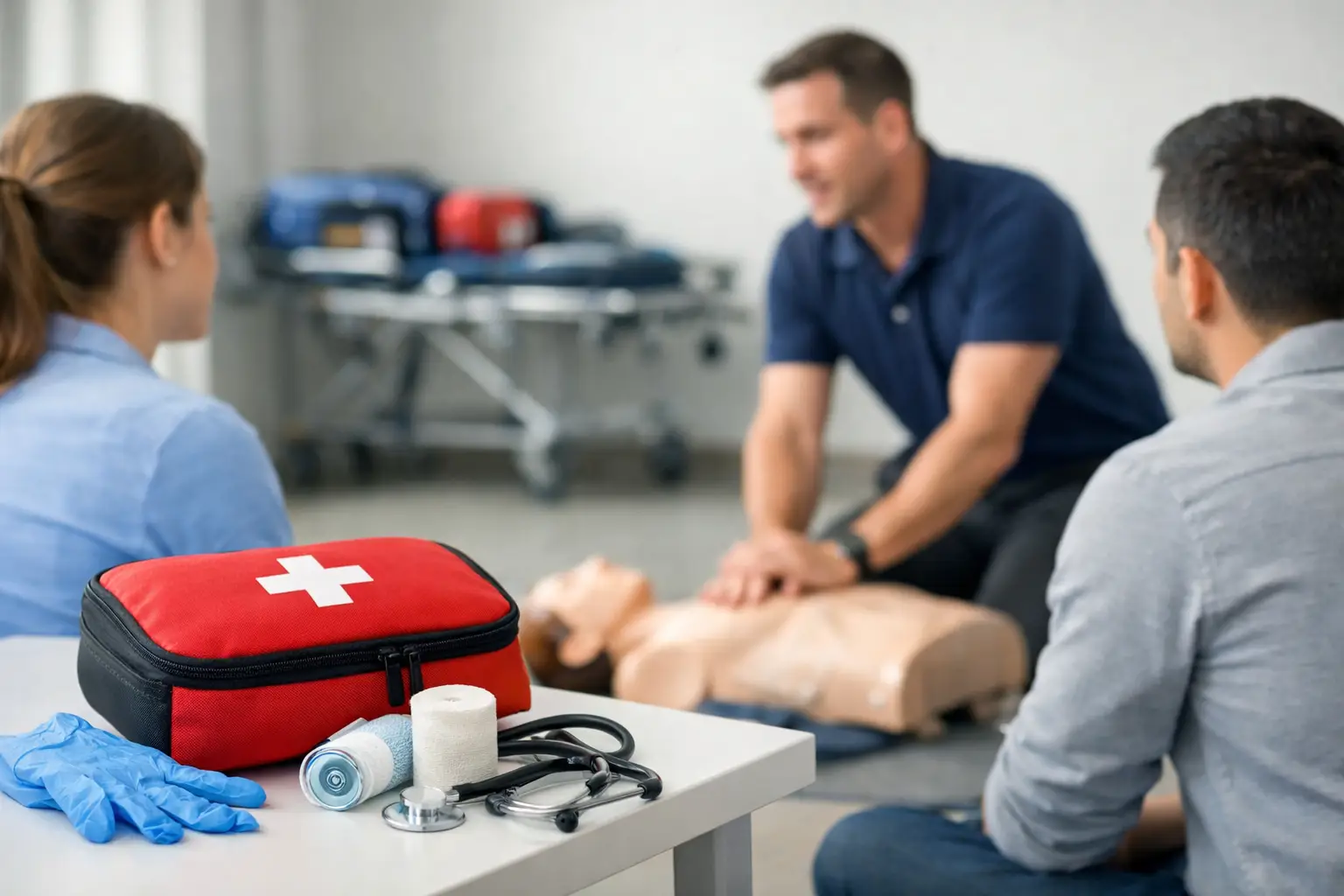
If there is one factor that separates useful training from weak training, it is hands-on repetition. Learners need to practice skills physically, not just hear about them. Bandaging, bleeding control, recovery position, choking response, and scene assessment all improve with guided repetition.
Hands-on training also exposes hesitation. Many people think they are ready until an instructor places them in a timed scenario and asks them to act. That gap is normal, and it is exactly why realistic practice matters. A good provider creates enough structure to build competence without making learners feel overwhelmed.
This is also why class size matters. A crowded class may be efficient for the provider, but it can reduce feedback and hands-on time for each participant. Smaller groups or well-managed sessions usually produce better skill retention. Convenience has value, but not if it comes at the cost of confidence and performance.
Certification matters, but it is not the whole story
Many buyers focus almost entirely on whether a card is issued at the end of class. That is understandable, especially for jobs that require proof of completion. Still, certification alone is not a reliable measure of training quality.
A credible provider should be transparent about the certifying body, course acceptance, renewal expectations, and what the training actually covers. If you need the course for employment, licensing, or regulated workplace compliance, verify those requirements before enrolling. The best provider will not be vague about it.
At the same time, do not confuse a fast certificate with strong readiness. Some courses are designed to move people through quickly. That may meet a narrow administrative need, but it does not always prepare them to respond well in a real emergency. If seconds count, practical competence matters more than paperwork.
Questions worth asking before you book
A serious training provider should be able to answer direct questions without sales language or unclear promises. Ask who the course is designed for, how much hands-on practice is included, whether scenarios are part of instruction, and what credentials the instructors hold. Ask whether the course meets your employer’s or industry’s requirements if that applies to you.
It is also worth asking how often the content is updated. First aid guidance evolves. Training should reflect current standards, not outdated habits passed along by repetition. Providers that stay current tend to be more disciplined overall.
Scheduling flexibility matters too, especially for employers and healthcare teams. The best provider is not simply the one with the most open seats. It is the one that can deliver dependable instruction in a format that makes sense for the group without lowering the standard of practice.
Red flags that should make you pause
Be cautious of providers that treat training like a commodity. If the marketing focuses only on speed, low price, or easy certification, that can be a sign that instructional quality is secondary. Emergency response training should be efficient, but it should never feel disposable.
Another red flag is a course that is too generic. If a provider cannot explain how the training applies to your setting, they may not understand the real demands of response. Families, schools, workplaces, and clinics each face different risks and decisions.
Poor communication is also a warning sign. If you have trouble getting straight answers before enrollment, you may have trouble getting support after the course as well. In training, clarity is part of credibility.
Local access can improve readiness
Location is not the top factor, but it can make a difference when training needs to be repeated, coordinated across teams, or scheduled around work and family demands. For employers managing staff in cities like Phoenix, Las Vegas, Denver, or Seattle, consistent regional access can simplify compliance and keep skills current. For individual learners, nearby training often makes it easier to attend, refresh, and stay engaged over time.
That is especially useful when your needs may grow beyond a single first aid course. A provider that also offers CPR, BLS, ACLS, PALS, and workplace training can support a learner from first exposure to advanced certification. Community Responders LLC is one example of that broader model, serving both public and professional audiences with a practical focus on emergency response.
The right choice is rarely the cheapest one
Cost matters. So do time, scheduling, and convenience. But first aid training is one of those decisions where the lowest price can become the highest risk. If training leaves people uncertain, slow to respond, or confused about basic priorities, the savings disappear the moment an emergency happens.
The best first aid training provider gives learners something more durable than a completion record. It gives them a workable response pattern they can recall under stress. That includes staying calm, recognizing what is urgent, taking the right first steps, and knowing when additional help is needed.
For some people, that means choosing a straightforward community course that covers the emergencies most likely to happen at home, school, or in public. For others, it means selecting a provider that can support workforce safety programs or advanced clinical education. The best fit depends on your role, your environment, and the level of responsibility you carry.
When you compare providers, keep the standard simple. Choose the one that treats training as preparation for a real event, not just a completed class. The value of first aid education shows up later, in the moment nobody planned for and everyone hopes they are ready to handle.