If you need CPR training, the question usually is not whether to get certified. It is which certification to choose. When people compare AHA vs Red Cross CPR, they are often trying to solve a practical problem fast: Will my employer accept it, will I learn what I need, and will I be ready to act when someone collapses?
That is the right way to frame it. CPR training is not just a box to check. The best course is the one that meets your job requirements, fits your environment, and gives you the confidence to respond correctly under pressure.
AHA vs Red Cross CPR: the short answer
Both the American Heart Association and the American Red Cross are widely recognized training organizations. Both teach CPR, AED use, and first aid. Both issue certifications used by employers, schools, childcare programs, and healthcare settings across the United States.
The difference is not that one teaches lifesaving care and the other does not. The real difference is acceptance, course structure, and audience fit. For many healthcare professionals, AHA training is the safer choice because hospitals and clinical employers often ask for it by name. For many workplaces, schools, parents, and general community learners, either option may be accepted, depending on the policy in place.
That is why the first question should never be, "Which is better overall?" It should be, "Which one is required where I will use it?"
Start with employer and licensing requirements
If you work in healthcare, this matters immediately. Many hospitals, clinics, surgery centers, and EMS-related roles specify American Heart Association BLS. Some will not accept an equivalent from another provider, even if the skills covered are similar.
If you are a nursing student, medical assistant, dental professional, physical therapist, or other licensed or pre-licensed healthcare worker, verify the requirement before enrolling. A course that is respected in general may still not meet a facility's internal policy. That can cost you time, money, and a delayed start date.
For non-clinical roles, the answer is often more flexible. Daycare staff, fitness professionals, teachers, coaches, security personnel, and workplace response teams may be allowed to use either AHA or Red Cross certification. Some employers simply require current CPR and AED training from a recognized organization. Others are more specific.
Families and individual community members usually have the most freedom. If you want CPR skills for home, childcare, youth sports, or general preparedness, the best program is the one that gives you strong hands-on practice and clear instruction.
What each organization is known for
The American Heart Association has a strong presence in professional healthcare education. It is closely associated with BLS, ACLS, and PALS training, and its programs are often built into hospital onboarding, credentialing, and continuing education pathways. For learners in clinical environments, that familiarity matters.
The Red Cross is also well known and widely trusted, especially in community education, workplace programs, aquatics, childcare, and general first aid instruction. Many people encounter Red Cross training through employers, schools, or public safety programs rather than through hospital systems.
Neither reputation is accidental. Each organization has built training systems around different common use cases. That is why the best fit often depends on where you plan to use the certification, not just what the card says.
Is there a difference in the CPR skills taught?
At the core, both teach the essentials of recognizing cardiac arrest, calling 911, starting high-quality compressions, using an AED, and giving breaths when appropriate. Both aim to prepare people to act during the first critical minutes of an emergency.
In practical terms, a well-run class from either organization should teach you how to assess the scene, identify an unresponsive person, and begin CPR quickly. If the instruction is strong and the students get meaningful practice, the skill outcome can be very similar.
Where variation shows up is often in course design, teaching format, terminology emphasis, and the amount of hands-on coaching. One instructor may push students harder on compression quality, teamwork, and real-world scenarios. Another may stay closer to the minimum standards needed to complete the course. That is not always an AHA-versus-Red-Cross issue. Often, it is a training-center and instructor issue.
That matters more than many people realize. A certification card proves completion. It does not guarantee readiness. Readiness comes from repetition, correction, and realistic practice.
AHA vs Red Cross CPR for healthcare professionals
For healthcare audiences, the comparison is usually straightforward. If your employer, school, or licensing pathway names AHA, choose AHA. Do not assume an equivalent will be accepted later.
This is especially common with BLS. Clinical teams often want standardized training language and a credential that aligns with internal policy. The same logic applies at higher levels, where ACLS and PALS expectations are often very specific.
If you are a healthcare worker and the employer says either is acceptable, then look at format, scheduling, and skill depth. Ask how much in-person practice the course includes. Ask whether the class reflects team-based response, bag-mask ventilation, and the pace you may face in a patient care setting. For professionals, convenience matters, but realism matters more.
AHA vs Red Cross CPR for workplaces and families
For non-medical audiences, the decision can be more flexible. A workplace CPR course for an office, warehouse, school, church, or retail team should focus on rapid recognition, AED confidence, and clear role assignment during an emergency. If both certifications are accepted, choose the provider that offers stronger hands-on instruction and scheduling that works for your team.
For parents, grandparents, babysitters, and coaches, the same principle applies. You are not preparing for a credential review. You are preparing for the possibility of choking, collapse, drowning, or a child in distress. A class that gives you practical confidence is worth more than a class that simply issues a card.
This is where a community-centered training partner can make a difference. Community Responders LLC serves both everyday learners and professional audiences, which matters because the needs are different. A parent learning infant CPR should not be taught like a hospital code team. A nurse renewing BLS should not be trained like a first-time community student.
Online, blended, or in-person?
This is one of the biggest points of confusion. Many CPR courses now include online modules, blended learning, or fully in-person formats. That can be useful, but it also creates a trade-off.
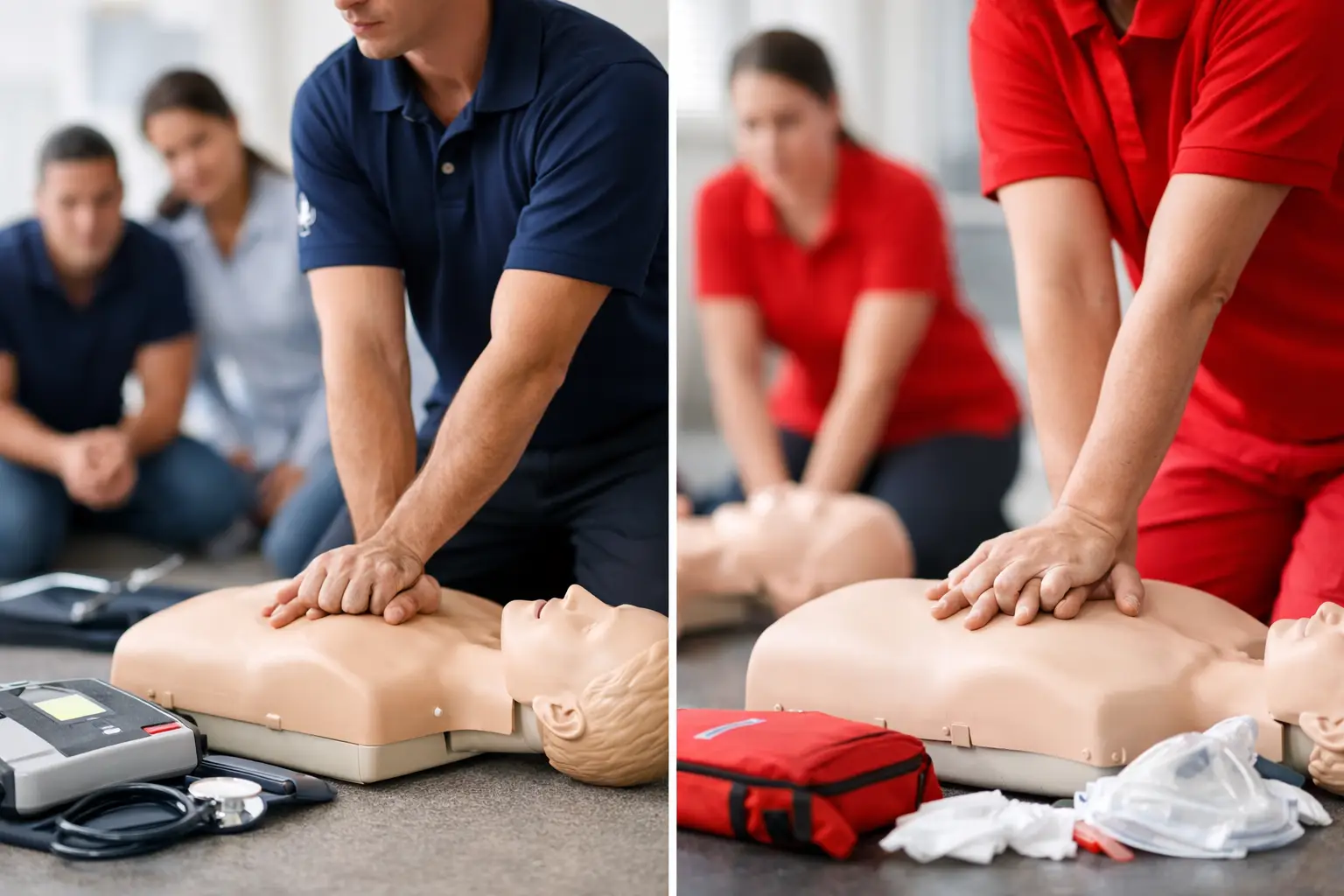
Online learning is convenient and can help with knowledge review. Blended learning can save time by moving lecture content out of the classroom. But CPR is a psychomotor skill. You need to practice compressions, ventilation technique, AED application, and response sequence with coaching.
If your job allows blended training, it may be a good option. If you are brand new to CPR, fully in-person instruction often gives better skill retention and more confidence. When seconds count, muscle memory matters.
What to ask before you register
Before choosing between AHA and Red Cross, ask a few direct questions. Will my employer or school accept this certification? Is the course adult-only, or does it include child and infant CPR? Is AED training included? How much hands-on practice will I get? Who is teaching the class, and what is their real-world background?
Those questions cut through marketing fast. They also help you avoid the most common mistake, which is selecting based only on price or convenience.
A cheaper course is not a better value if you finish unsure of what to do. A fast course is not efficient if you have to retake it because your employer rejects it.
So which one should you take?
If you work in healthcare or expect to work in healthcare, AHA is often the safest choice because it is frequently required by name. If you are training for workplace compliance, childcare, coaching, or personal preparedness, either AHA or Red Cross may work, provided the certification is accepted and the instruction is solid.
If both are accepted, shift your focus from the logo to the learning experience. Look for a class that includes meaningful practice, clear feedback, and scenario-based instruction that reflects the situations you may actually face. That is where confidence is built.
The right CPR course is the one that leaves you ready to act, not just certified. When someone stops breathing, collapses, or starts choking, there is no time to wish your training had been better. Choose the program that matches your requirements, respects the seriousness of the skill, and prepares you to respond without hesitation.