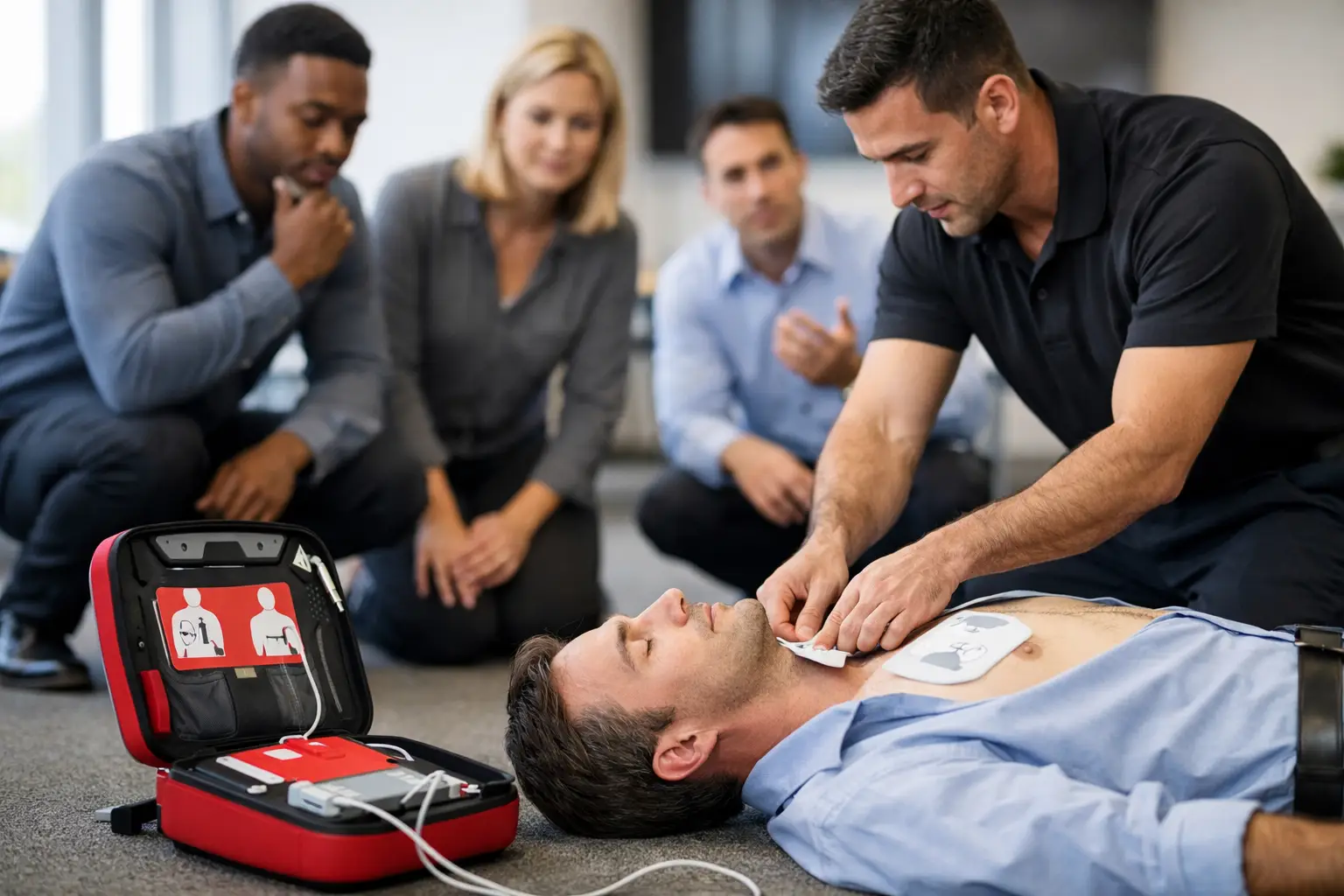
A person collapses in the break room. Someone calls 911. Someone else runs to find the AED mounted near the front desk. What happens next depends on one thing - whether the people nearby have had AED training at work and know how to act without freezing.
That is why this training matters. Cardiac arrest does not wait for medical staff, and it does not only happen in hospitals, gyms, or public venues. It can happen in offices, warehouses, schools, retail stores, construction sites, and healthcare settings. When employees know how to recognize sudden cardiac arrest, start CPR, and use an automated external defibrillator quickly, they give the victim a far better chance of survival.
Why AED training at work matters
An AED is designed to be used by non-physicians, but that does not mean training is optional. In a real emergency, people are dealing with panic, noise, confusion, and the pressure of acting in front of coworkers. Even simple devices can feel difficult when the moment is critical.
Training closes that gap. It teaches employees what sudden cardiac arrest looks like, when to call for help, how to begin CPR, and how to use the AED safely and without delay. Just as important, it gives people a mental script. That matters because hesitation is one of the biggest barriers to effective response.
For employers, there is also a broader safety issue. An AED on the wall is useful only if the team knows where it is, who retrieves it, and how the emergency response should unfold. Without training, workplaces often overestimate their readiness. They assume common sense will take over. In practice, response plans break down when roles are unclear.
What employees should learn during AED training at work
Good workplace AED instruction is not limited to pressing a button on the device. The strongest programs teach the full response sequence, because defibrillation works best as part of an organized chain of survival.
Employees should learn how to identify an unresponsive person who is not breathing normally, activate EMS, begin high-quality CPR, and apply the AED as soon as it arrives. They should also understand voice prompts, pad placement, scene safety, and what to do after a shock is delivered or if no shock is advised.
Workplace-specific details matter too. A strong course addresses how the response works in that setting, not just in theory. In an office, that may mean assigning someone to meet paramedics in the lobby. In a warehouse, it may mean planning around noise, distance, or limited access points. In a medical office or dental clinic, the training may need to fit a more advanced emergency response workflow.
This is where practical instruction makes the difference. Employees need hands-on practice, not just policy language or a short video during onboarding.
One size does not fit every workplace
The right AED training program depends on the work environment, team size, risk profile, and whether employees already hold CPR or BLS credentials. A manufacturing site with large floor space has different needs than a small retail shop. A school may need broader staff coverage because of the number of students and visitors on site. A healthcare team may need a higher level of integration with clinical emergency protocols.
That is why employers should avoid treating training as a box to check. Compliance matters, but readiness matters more. If the course content does not match the real setting, retention drops and confidence drops with it.
Some organizations train a designated response team. Others train all staff. There is no universal answer. A designated team can be efficient, especially in larger operations, but it creates risk if key people are absent, off shift, or on the other side of the building. Training more employees often provides better coverage, though it requires more time and budget. The right choice depends on staffing patterns and how quickly trained responders can realistically reach the victim.
AED placement and training should work together
Training is only part of the equation. Employees also need to know where the AED is located and how to access it without delay. If the device is locked away, poorly marked, or too far from likely incident areas, response time suffers.
This is why AED planning and AED training at work should be handled together. During training, employees should practice retrieving the device from its actual location, if possible. They should know who calls 911, who starts compressions, who brings the AED, and who directs emergency responders to the scene.
Employers should also think through shift coverage, visitor traffic, and any physical barriers in the workplace. A building may technically have an AED but still be poorly prepared if the device cannot be reached quickly from high-occupancy or high-risk areas.
Confidence is not the same as competence
Many employees assume they would know what to do in an emergency. That confidence often disappears when they face a collapsed coworker, an alarm from the AED cabinet, and a room full of people looking for direction. Training should be designed to build both competence and composure.
The best instructors do this by using realistic scenarios and repetition. When participants physically perform the steps, hear the prompts, and practice communication under pressure, the process becomes more familiar. Familiarity reduces delay.
There is also value in refreshing skills regularly. People forget details, especially if they never use them. A team trained two years ago may not respond with the same speed or accuracy today. If there has been turnover, layout changes, or a new AED model installed, refresher training becomes even more important.
Common employer questions about workplace AED training
A frequent question is whether every employee needs certification. The answer depends on the workplace and the employer's goals. Some organizations want formal CPR and AED certification for broad staff groups. Others want practical onsite training focused on internal emergency response. Certification can add consistency and documentation, but what matters most is that employees can perform under pressure.
Another question is whether AEDs are too technical for non-medical staff. They are not. These devices are built for guided use, with clear prompts that walk the rescuer through each step. Training is still critical, not because the device is complicated, but because emergencies are.
Employers also ask how often training should happen. There is no perfect schedule for every site, but waiting until a certification expires is not always enough. High-turnover workplaces, public-facing businesses, and sites with multiple shifts often benefit from more frequent review and drills.
Building a stronger response culture
AED readiness is not only about one emergency device. It reflects a workplace culture that takes health and safety seriously. When employees are trained, they understand that emergency response is part of shared responsibility, not something left entirely to outside help.
That culture matters beyond cardiac arrest. Teams that train together tend to communicate better in urgent situations, follow procedures more reliably, and feel more prepared when something unexpected happens. The value is practical. People are more likely to step forward when they have been shown exactly how to help.
For multi-site employers or organizations with teams across cities such as Phoenix, Las Vegas, Denver, or Seattle, consistency becomes especially important. A standardized approach to CPR and AED readiness can help reduce confusion across locations while still allowing for site-specific planning.
Community Responders LLC works in that space between compliance and real readiness. The goal is not simply to place a device on the wall. It is to make sure the people standing closest to an emergency know how to respond when seconds count.
What to look for in an AED training provider
Employers should look for training that is hands-on, current, and relevant to the workplace itself. The provider should be able to teach lay responders clearly, answer operational questions, and adapt scenarios to the audience. For healthcare teams, the instruction should also align with professional standards and the realities of clinical response.
It also helps to work with a provider who understands that not all learners come in with the same comfort level. Some participants are anxious about doing harm. Others are confident but have gaps in technique. Effective instruction addresses both. It is direct, practical, and focused on performance, not just information.
A workplace is safer when people know what to do before the emergency starts. That is the real value of AED training - not theory, not paperwork, but a faster, more capable response when someone’s life depends on it.